
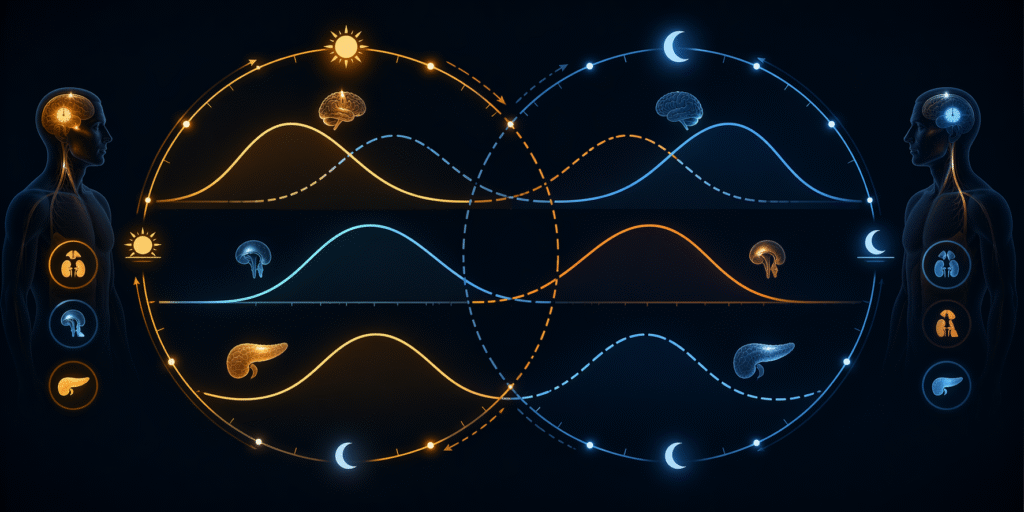
Circadian rhythm and metabolism are connected more directly than most people — and most doctors — realize. If you eat well, exercise regularly, and still struggle with energy crashes, stubborn weight, poor sleep, or rising fasting glucose, your body clock may be the missing piece. Every metabolic process in your body — insulin secretion, liver glucose production, cortisol rhythm, fat burning — follows a precise 24-hour timing program. When that program is disrupted by late eating, artificial light, or irregular sleep, your metabolism pays the price regardless of what is on your plate.
How Circadian Rhythm Disruption Silently Drives Insulin Resistance
Your body does not process food the same way at 8am and at 8pm. It does not secrete cortisol evenly across the day. It does not handle glucose, insulin, or fat oxidation in a timeless vacuum. Every one of these processes runs on a precise 24-hour biological clock — and when that clock is disrupted, metabolism pays the price regardless of what is on your plate.
Circadian rhythm disruption and metabolism are connected at a fundamental level. This is not about feeling tired. It is about the hormonal and cellular timing system that determines when your body is prepared to handle fuel, secrete insulin, and clear glucose — and what happens when that system runs out of phase with the actual time of day.
This post explains the mechanism, the clinical pattern, and what changes when timing is corrected.
What you will learn:
How the central and peripheral body clocks govern insulin sensitivity | Why circadian misalignment creates metabolic dysfunction independent of diet | The clinical profile of the patient whose body clock is the hidden variable | What lab markers suggest timing is the problem | What realignment actually looks like in practice
The Body Clock System: Central and Peripheral Clocks
The circadian system is not a single clock. It is a hierarchy.
The central clock sits in the suprachiasmatic nucleus (SCN) of the hypothalamus. It is set primarily by light — specifically by morning light exposure through the retina. This central clock then sends timing signals to peripheral clocks located in every metabolically relevant organ: the liver, pancreas, skeletal muscle, and adipose tissue.
Each peripheral clock governs the timing of local metabolic processes. The liver clock controls the rhythm of glucose output and lipid metabolism. The pancreatic clock governs the timing and magnitude of insulin secretion. The muscle clock regulates glucose uptake and fuel oxidation.
Under normal conditions, these clocks are synchronized. They receive the same temporal cues — light, feeding time, cortisol rhythm, temperature — and they run together. Insulin sensitivity is highest in the morning and early afternoon. Glucose tolerance is strongest early in the biological day. Cortisol peaks sharply after waking to mobilize energy and then declines through the afternoon and evening.
When circadian rhythms are disrupted — through late-night light exposure, delayed sleep, irregular meal timing, or shift work — the central and peripheral clocks fall out of synchrony with each other. The liver is operating on one schedule. The pancreas on another. The result is a system that is metabolically mistimed rather than simply impaired.
What Circadian Disruption Actually Does to Insulin Sensitivity
Insulin sensitivity follows a strict circadian pattern. It peaks in the first half of the biological day and falls progressively through the afternoon and evening. This is not incidental. It is a programmed preparation for the overnight fast — the body expects that fuel intake will stop, and it downregulates glucose disposal capacity accordingly.
When meals are pushed into the evening and night — which is standard in most modern schedules — food arrives at precisely the time when insulin sensitivity is at its lowest. The same meal eaten at noon and at 9pm produces a measurably different glucose and insulin response. The diet has not changed. The metabolic context has.
Late eating also directly suppresses melatonin signaling in the pancreas. Melatonin receptors on pancreatic beta cells modulate insulin secretion timing. When melatonin rises in the evening — as it should — it signals the pancreas to reduce insulin output in preparation for overnight fasting. Late food intake sends a conflicting signal: it demands insulin at the exact moment the biological clock is telling the pancreas to stand down. The result is impaired glucose clearance and a prolonged postprandial insulin response.
Simultaneously, high evening light exposure — screens, overhead LED lighting, phone use — suppresses melatonin onset and delays the circadian phase. The internal clock shifts later. Cortisol timing follows. The morning cortisol awakening response, which should produce a sharp rise within 30 minutes of waking and drive glucose mobilization and metabolic activation, becomes blunted and delayed. The patient wakes fatigued, glucose regulation is sluggish through the morning, and energy only picks up in the late afternoon — by which point the metabolic window for efficient fuel handling is closing again.
This is the core of circadian metabolic dysfunction: the timing of hormonal readiness and the timing of actual food intake and light exposure are running on different schedules.
Clinical Perspective: What I See in Practice
The circadian-disrupted patient follows a pattern that has become entirely predictable.
Mornings are the biggest miss. They wake by alarm, not by light. They spend the first hours indoors under artificial or dim light. There is no strong circadian start signal — cortisol rises weakly, melatonin lingers, and the body’s metabolic activation is delayed.
Through the day they work mostly indoors, under consistent artificial lighting with minimal variation, minimal outdoor exposure, and high cognitive load. The circadian signal that should vary in strength across the day remains flat. There is no amplitude.
In the evening the pattern accelerates. Meals drift to 20:00 or later. Cognitive work continues. Screens remain on. Overhead LED lighting stays bright. Melatonin suppression extends the biological day far past what the body was designed to handle. Sleep comes at midnight to 01:30 — driven by exhaustion, not by biological readiness.
The result is five to six and a half hours of fragmented sleep from a phase-delayed clock, followed by an alarm-driven wake into a dim indoor morning. And the cycle repeats.
Before these patients mention sleep at all, the clinical picture already suggests the clock is off. They describe morning fatigue despite adequate hours, a second wind at 10 or 11pm, post-meal crashes in the afternoon, brain fog in the morning that clears at night, and the characteristic “tired but wired” presentation at bedtime. Their energy and glucose regulation are not simply impaired — they are phase-shifted. That distinction is the clinical key.
The lab picture confirms it: fasting glucose sitting between 100 and 115 mg/dL despite a clean diet, insulin plateaued, triglycerides mildly elevated despite low refined carbohydrate intake, and HbA1c trending between 5.7 and 6.1% without clear progression or resolution.
The cases that demonstrate circadian misalignment most clearly are those where diet is already structured — stable protein, low refined carbohydrates, appropriate meal size — and the markers are still not moving. The intervention in these cases involves no dietary change. Only timing and light correction: morning light within 30 minutes of waking, a fixed wake time seven days per week, sleep shifted to approximately 22:30–23:00, the last meal moved to before 19:00–20:00, and evening light minimized.
Within two to six weeks, fasting glucose drops 8 to 15 mg/dL. Triglycerides begin to fall. Insulin sensitivity improves — often first visible as more consistent readings rather than a dramatic single drop. Energy normalizes within the first week. HbA1c trends down over eight to twelve weeks.
Nothing new was added nutritionally. The existing physiology was realigned with its own timing system. The cortisol awakening response restored. Melatonin timing normalized. The peripheral clocks in liver and muscle re-synchronized. The same diet that was producing no movement suddenly started working — because the timing block was removed.
The framing that consistently shifts patient understanding is direct: “Your metabolism doesn’t just care what you eat — it cares when your body thinks it is.” The analogy that lands is equally simple: eating a perfect meal at midnight is still metabolically inappropriate, because the body is not prepared to handle it. Once patients understand that their body is running on the wrong schedule — not just that they need more sleep — the intervention becomes meaningful rather than optional.
Social Jet Lag: The Weekly Circadian Reset That Isn’t
One of the most common and least recognized forms of circadian disruption does not require shift work or transatlantic travel. It happens every weekend.
Social jet lag describes the discrepancy between the biological clock and the social schedule — the shift in sleep timing between weekdays and weekends. A patient sleeping from midnight to 06:30 on weekdays and from 01:30 to 09:30 on weekends is shifting their biological clock by approximately two hours, twice per week, every week.
The metabolic consequences mirror those of actual time zone travel. Each Monday, the peripheral clocks in the liver and pancreas are running on a different schedule than the central clock. Glucose metabolism is impaired in proportion to the magnitude of the shift. Insulin sensitivity is lower on Monday morning than it was on Friday morning — not because of weekend diet, but because of weekend timing.
Research consistently shows that even one hour of social jet lag is associated with measurably higher fasting insulin, elevated triglycerides, and increased risk of metabolic syndrome. The effect scales with the size of the shift. And because the shift is self-inflicted and entirely normalized — sleeping in on weekends is universal — patients never identify it as a metabolic variable.
Fixing social jet lag requires a consistent wake time seven days per week. Not a strict identical bedtime — but a fixed wake time that anchors the clock regardless of when sleep began. This single intervention, applied consistently, often produces measurable metabolic improvement within three to four weeks.
The Liver Clock and Hepatic Glucose Dysregulation
The liver is the organ most immediately affected by circadian disruption, and its clock-dependent behavior has direct consequences for fasting glucose and insulin resistance.
Under normal circadian conditions, hepatic glucose output follows a precise overnight arc. The liver releases glucose during the night to maintain stable fasting levels, then reduces output as insulin rises in the morning following the cortisol awakening response. This rhythm is governed by the liver’s own peripheral clock genes — specifically the expression of enzymes controlling gluconeogenesis and glycogen metabolism.
When the liver clock is desynchronized — through late eating, shift work, or chronic circadian misalignment — this arc breaks down. Hepatic glucose output continues at inappropriate times. Gluconeogenesis runs when it should be suppressed. The result is fasting glucose that is elevated not because the patient ate carbohydrates, but because the liver is producing glucose on a disrupted schedule.
This is why the clean-diet patient with persistently elevated fasting glucose is such a recognizable clinical phenotype. Their dietary glucose load is controlled. Their hepatic glucose output is not — because the clock governing it is running out of phase. No dietary intervention corrects a liver clock problem. Only timing correction does.
This mechanism also explains why fatty liver and circadian disruption are so frequently co-present. The liver clock governs not only glucose output but lipid metabolism. A desynchronized liver clock produces dysregulated de novo lipogenesis — the liver manufactures fat at the wrong time, in excess, and accumulates it locally. Elevated triglycerides in a patient with a clean diet and late eating habits are often a direct readout of this process.
Cortisol Rhythm, the Awakening Response, and Morning Glucose
Cortisol is the body’s primary circadian anchor hormone. Its rhythm — nadir around 2am, sharp rise in the pre-dawn hours, peak within 30 to 45 minutes of waking, then a progressive decline through the day — coordinates the timing of virtually every downstream metabolic process.
The cortisol awakening response (CAR) is particularly important metabolically. This sharp post-waking spike mobilizes glucose, activates gluconeogenesis transiently, prepares skeletal muscle for insulin-stimulated uptake, and synchronizes the peripheral clocks in the liver and pancreas with the light-dark signal. When the CAR is robust and timed correctly, the system starts the metabolic day with coherent signaling.
Chronic circadian disruption flattens the CAR. Nighttime cortisol rises when it should be near its nadir. The morning peak blunts. The diurnal decline becomes poorly defined. The clinical consequence is a patient whose metabolic day never properly starts — morning glucose regulation is sluggish, insulin sensitivity fails to peak at the right time, and the system drifts into an afternoon and evening with no clear hormonal transition back toward fasting mode.
This is also why the HOMA-IR calculation in these patients often reveals more insulin resistance than their diet would predict. The insulin resistance is not primarily dietary in origin. It is temporally driven — sustained by a cortisol rhythm that has lost its structure.
Shift Work as a Model of Circadian-Metabolic Dysfunction
Shift workers provide the clearest clinical model of what chronic circadian disruption does to metabolism over time, because in shift work the disruption is total and persistent.
Night shift and rotating shift workers eat, sleep, and are exposed to light at times that are directly opposed to the biological clock. Their peripheral organ clocks attempt to remain anchored to the light-dark cycle while the behavioral schedule runs in the opposite direction. The result is a chronic state of internal desynchrony — the liver clock running on solar time while the behavioral schedule runs on night shift time, with neither ever fully winning.
The metabolic consequences are well-documented. Shift workers have significantly higher rates of insulin resistance, type 2 diabetes, central adiposity, dyslipidemia, and non-alcoholic fatty liver disease than matched day workers — controlling for diet, exercise, and socioeconomic factors. The excess risk is attributable to the circadian disruption itself, not to confounding lifestyle variables.
The shift work model is clinically instructive beyond shift workers. It demonstrates that circadian misalignment — even without a single dietary change — is independently sufficient to drive insulin resistance and dyslipidemia. For the executive sleeping at 01:00, eating at 21:00, and spending evenings under bright screens, the biology is operating on a scaled version of the same mechanism. The severity differs. The pathway does not.
What Circadian Realignment Looks Like in Practice
Correcting circadian disruption does not require pharmaceutical intervention or dramatic lifestyle restructuring. It requires consistency with a small number of high-leverage inputs.
Morning light is the most powerful circadian resynchronizer available. Ten to twenty minutes of direct outdoor light exposure within thirty minutes of waking resets the central clock, initiates the cortisol awakening response at the correct time, and begins anchoring the downstream peripheral clocks. In the absence of outdoor light, a 10,000 lux light therapy lamp is an effective substitute.
Wake time consistency matters more than bedtime. The biological clock is primarily anchored by the wake signal — the combination of light exposure and cortisol rise that resets the clock each morning. A fixed wake time seven days per week, even after a late night, provides a consistent anchor. Varying wake time by more than 45 minutes between days perpetuates the social jet lag effect.
Meal timing is the most powerful input for peripheral clock synchronization. Moving the first meal earlier and the last meal to before 19:00–20:00 aligns feeding with the biological window of highest insulin sensitivity. This single change — without altering what is eaten — consistently improves postprandial glucose and overnight fasting glucose in circadian-disrupted patients.
Evening light reduction is the intervention most patients resist and most underestimate. Overhead LED lighting and screen use in the two hours before sleep suppresses melatonin onset by 60 to 90 minutes in most adults. Switching to dim, warm lighting after 20:00 and reducing screen brightness in the final hour before sleep accelerates melatonin onset, advances circadian phase progressively over days, and improves both sleep architecture and morning cortisol timing.
These four inputs — morning light, fixed wake time, earlier last meal, reduced evening light — do not require any dietary change. They recalibrate the timing system within which the diet operates. In patients where circadian misalignment is the rate limiter, this recalibration is what allows the existing dietary and metabolic work to finally produce results.
Circadian misalignment and sleep deprivation are related but distinct mechanisms. Misalignment is a timing problem — the clock is running on the wrong schedule. Sleep deprivation is a quantity and quality problem — the body is not getting sufficient recovery regardless of timing. In practice, most patients present with both simultaneously. For a detailed breakdown of the hormonal cascade that insufficient sleep specifically triggers, see How Poor Sleep Causes Insulin Resistance: The Hormonal Mechanism.
The full integration of these two mechanisms — and how they work together to govern insulin sensitivity, hepatic glucose output, hormonal rhythms, and metabolic health as a whole — is laid out in the cluster cornerstone on the master regulators of metabolic health.
A Note on Uncertainty
The relationship between circadian disruption and metabolic dysfunction is among the most robustly supported areas of chronobiology. The mechanisms — SCN-peripheral clock desynchrony, insulin sensitivity circadian variation, melatonin-pancreatic signaling, cortisol awakening response, hepatic clock-governed gluconeogenesis — are well-characterized in controlled human studies.
What is less precisely quantified is the magnitude of individual variation. Chronotype — whether a person is biologically earlier or later in their circadian phase — influences the severity of disruption produced by a given social schedule. Late chronotypes suffer disproportionate metabolic consequences from conventional 9-to-5 schedules compared to early chronotypes, because the mismatch between their biological clock and social demands is larger.
The clinical observations in this post reflect patterns seen repeatedly in practice. They are consistent with the mechanistic literature. They are not yet the subject of large randomized trials designed specifically to isolate circadian realignment as a therapeutic intervention in insulin resistance populations. That gap does not weaken the mechanistic case — it reflects the difficulty of designing behavioral chronotherapy trials.
Where sleep disorders, shift work health consequences, or pharmacological sleep interventions are under consideration, decisions should be made in collaboration with the treating physician.
People Also Ask About Circadian Rhythm And Metabolism
How does circadian rhythm disruption cause insulin resistance?
Circadian disruption desynchronizes the peripheral clocks in the liver, pancreas, and skeletal muscle from the central clock in the brain. This disrupts the timed rhythm of insulin sensitivity, hepatic glucose output, and cortisol signaling that governs how the body handles fuel. The result is impaired glucose clearance and elevated insulin — independent of dietary intake.
Can fixing your body clock improve blood sugar without changing diet?
Yes, and this is one of the clearest clinical demonstrations of circadian biology’s metabolic role. Patients with structured diets and plateaued fasting glucose frequently show drops of 8 to 15 mg/dL in fasting glucose within two to six weeks of circadian realignment — morning light, earlier meals, fixed wake time, reduced evening light — without any dietary change.
What is social jet lag and how does it affect metabolism?
Social jet lag is the weekly shift in sleep timing between weekdays and weekends. Even one to two hours of weekly sleep timing variation measurably impairs insulin sensitivity, raises fasting insulin, and elevates triglycerides. It is one of the most common and least recognized forms of circadian disruption in non-shift-working adults.
What are the signs that circadian disruption is driving metabolic dysfunction?
Key clinical indicators include morning fatigue despite adequate sleep hours, a second wind in the late evening, post-meal crashes in the afternoon, mildly elevated fasting glucose despite dietary compliance, plateaued fasting insulin, and elevated triglycerides without a clear dietary explanation. The pattern reflects phase-shifted energy and glucose regulation rather than straightforward metabolic impairment.
Why does late eating raise blood sugar even with a clean diet?
Insulin sensitivity follows a circadian decline through the afternoon and evening. The same meal eaten at noon and at 9pm produces a significantly different glucose and insulin response, because the peripheral clocks in the liver and muscle are no longer primed for efficient glucose disposal. Late eating also suppresses melatonin and sends conflicting signals to pancreatic beta cells at the moment the biological clock is preparing them for overnight downregulation.
What is the most effective first step for circadian realignment?
Morning light exposure within 30 minutes of waking — 10 to 20 minutes of direct outdoor light — is the single most powerful circadian resynchronizer. It resets the central clock, initiates the cortisol awakening response at the correct biological time, and begins the cascade of peripheral clock re-entrainment. Paired with a fixed wake time seven days per week, it produces measurable circadian phase correction within one to two weeks.
About the Author
Morteza Ariana is a State-Certified Functional Nutritionist based in Germany, specializing in insulin resistance, type 2 diabetes, and root-cause metabolic restoration. He holds advanced training in systems-based physiology and has worked with patients across the U.S. and Europe for over 10 years.
His clinical framework is built around a core principle that mainstream medicine consistently overlooks: chronically elevated insulin — not blood glucose — is the earliest and most actionable driver of metabolic disease. That conviction was shaped in part by his own experience with hyperinsulinemia in 2016, and deepened through a decade of clinical practice and the study of leading researchers in metabolic medicine including Benjamin Bikman, Joseph Kraft, Gerald Reaven, Jason Fung, and Stephen Phinney.
His work focuses on identifying and correcting the upstream metabolic signals — insulin load, liver-gut axis dysfunction, circadian misalignment, and micronutrient gaps — that standard screening misses entirely. Patient outcomes are documented, anonymized, and published on this site.
If this resonates, the next step is clarity
The Metabolic Restoration Blueprint is a structured 12-week framework designed to correct upstream metabolic drivers — not just manage symptoms.
Key References
- Scheer FA, Hilton MF, Mantzoros CS, Shea SA. Adverse metabolic and cardiovascular consequences of circadian misalignment. PNAS. 2009;106(11):4453–4458. 🔗 https://pubmed.ncbi.nlm.nih.gov/19255424/
- Spiegel K, Leproult R, Van Cauter E. Impact of sleep debt on metabolic and endocrine function. The Lancet. 1999;354(9188):1435–1439. 🔗 https://pubmed.ncbi.nlm.nih.gov/10543671/
- Leproult R, Holmbäck U, Van Cauter E. Circadian misalignment augments markers of insulin resistance and inflammation, independently of sleep loss. Diabetes. 2014;63(6):1860–1869. 🔗 https://pubmed.ncbi.nlm.nih.gov/24458353/
- Buxton OM, Cain SW, O’Connor SP, et al. Adverse metabolic consequences in humans of prolonged sleep restriction combined with circadian disruption. Science Translational Medicine. 2012;4(129). 🔗 https://pubmed.ncbi.nlm.nih.gov/22496545/
- Stenvers DJ, Scheer FAJL, Schrauwen P, la Fleur SE, Kalsbeek A. Circadian clocks and insulin resistance. Nature Reviews Endocrinology. 2019;15(2):75–89. 🔗 https://pubmed.ncbi.nlm.nih.gov/30531917/
- Roenneberg T, Allebrandt KV, Merrow M, Vetter C. Social jetlag and obesity. Current Biology. 2012;22(10):939–943. 🔗 https://pubmed.ncbi.nlm.nih.gov/22578422/
- Garaulet M, Gómez-Abellán P, Alburquerque-Béjar JJ, et al. Timing of food intake predicts weight loss effectiveness. International Journal of Obesity. 2013;37(4):604–611. 🔗 https://pubmed.ncbi.nlm.nih.gov/23357955/
- Knutsson A. Health disorders of shift workers. Occupational Medicine. 2003;53(2):103–108. 🔗 https://pubmed.ncbi.nlm.nih.gov/12637595/
- Bass J, Takahashi JS. Circadian integration of metabolism and energetics. Science. 2010;330(6009):1349–1354. 🔗 https://pubmed.ncbi.nlm.nih.gov/21127246/
- Panda S. Circadian physiology of metabolism. Science. 2016;354(6315):1008–1015. 🔗 https://pubmed.ncbi.nlm.nih.gov/27885007/
- Eckel-Mahan KL, Sassone-Corsi P. Metabolism and the circadian clock converge. Physiological Reviews. 2013;93(1):107–135. 🔗 https://pubmed.ncbi.nlm.nih.gov/23303907/
- Poggiogalle E, Jamshed H, Peterson CM. Circadian regulation of glucose, lipid, and energy metabolism in humans. Metabolism. 2018;84:11–27. 🔗 https://pubmed.ncbi.nlm.nih.gov/29195759/