
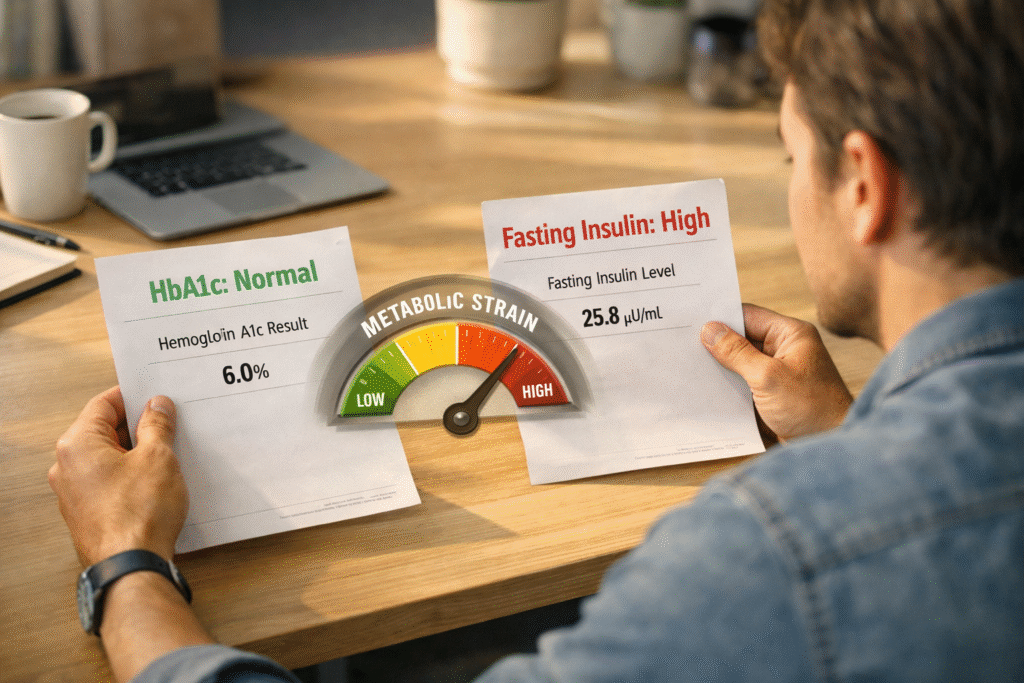
A fasting insulin test costs less than most routine blood markers, requires nothing more than a standard morning blood draw, and provides direct information about a hormone that drives a significant portion of chronic metabolic disease. It is not a specialized test. It does not require referral to an endocrinologist. The technology has existed for decades.
And almost no patient in conventional German primary care has ever had it ordered.
This is not a story about a missing exotic biomarker. It is a story about a structural blind spot in modern medicine — a hormone that we have known matters since the 1970s, that drives metabolic dysfunction for years before glucose ever becomes abnormal, and that sits outside the routine screening panel anyway. The cost of this blind spot is measurable in patient outcomes: a decade or more of compensatory hyperinsulinemia operating silently while the patient is repeatedly told their labs are fine.
In my clinical practice in Germany, the question I hear most often when I tell a new patient I need them to order fasting insulin is not technical. It is emotional. Why has nobody ever mentioned this before? The patients are not asking out of curiosity. They are asking because they have been doing yearly checkups for ten or fifteen years, getting cholesterol panels and glucose tests and HbA1c readings, and nobody — across all those appointments — has ever named the hormone that was actually driving their slow metabolic decline.
This article explains what the fasting insulin test measures, why HbA1c and glucose alone systematically fail to catch early dysfunction, why standard primary care does not order this test despite its low cost and clinical value, what to expect when you request it from your GP, and how to access it when the conventional system refuses to provide it.
What you will learn: What fasting insulin is and what the test measures | Why HbA1c and fasting glucose miss the compensatory phase entirely | The structural reasons fasting insulin is not part of routine screening in German primary care | The patient experience of requesting fasting insulin from a conventional GP | How to access the test when conventional care refuses to order it | A documented case showing what changes when a patient finally gets tested
Clinical Perspective: What I See in Practice
When I first tell a new patient that I want to see their fasting insulin, the most common reaction is not curiosity about the test. It is confusion. Why has nobody ever mentioned this before? The patient has typically had yearly glucose checks, HbA1c checks, and cholesterol panels for ten or fifteen years. The blood draws have been done. The labs have been ordered. Nobody — across all those years and all those appointments — has explained that the body can be metabolically dysfunctional long before glucose becomes frankly diabetic.
That single sentence usually does the most work in the consultation. Long before glucose becomes diabetic. Because glucose is a late marker. The body compensates for years by producing more insulin to keep glucose appearing normal on the lab report. That compensatory phase — which we have explored in detail in the dedicated post on normal blood sugar but insulin resistance — can last a decade or longer before overt type 2 diabetes appears on any panel.
When I explain fasting insulin to a patient for the first time, the framing I have found most effective is this: “We are not only interested in how much sugar is in the bloodstream. We are interested in how much insulin your body must produce to keep it there.
Two people can have the same glucose level with completely different metabolic physiology.” This is almost always a completely new concept for the patient. They have been taught — implicitly, by the way standard panels are presented to them — that glucose is the metabolic marker. They have not been told that glucose is the late marker. That the early marker, the one that would have caught the dysfunction a decade ago, was fasting insulin — and that it was never measured.
The second thing that happens after this conversation is that patients go back to their GP and request fasting insulin. That conversation itself is revealing. The responses they bring back are remarkably consistent across patients. It’s not necessary. Your glucose is normal. Insurance doesn’t cover it routinely. We don’t do that. Everything is fine. The patient leaves dismissed. They often feel they have been treated as if they have made an unreasonable request.
Just yesterday I had this exact conversation with a patient from Poland living in Germany. She had been asking her physician here for a proper thyroid workup alongside metabolic markers — including fasting insulin — and had been refused repeatedly. Her symptoms were minimized. The appointment lasted a few minutes. The physician was mostly looking at the computer screen.
She finally flew back to Poland and paid privately for the comprehensive workup that her German healthcare system would not provide. Unfortunately, I hear this increasingly often. Patients repeatedly describe the same experience: a consultation lasting only minutes, a physician focused on the screen, the patient barely able to explain symptoms properly, and a refusal to order the markers that would actually answer the clinical question.
The deeper systemic issue, in my view, is that modern medicine is structurally optimized for diagnosing established disease — not for identifying compensatory physiology. Fasting insulin sits exactly in that blind spot. We have known since the work of Joseph Kraft in the 1970s that hyperinsulinemia can precede overt type 2 diabetes by many years. Kraft examined fasting and post-load insulin patterns in tens of thousands of patients and demonstrated that insulin dysregulation is detectable long before glucose dysregulation appears on any standard test. The research is not new. It is not controversial. It has been replicated in independent studies for fifty years.
And yet fasting insulin remained outside routine screening because the medical system is largely glucose-centric. It waits for glucose to fail instead of identifying insulin dysregulation while it is still operating in the compensatory range. Functionally, this makes very little sense. If a patient requires progressively more insulin to maintain the same glucose level, that is pathology developing — even if the glucose still appears acceptable on the panel. The insulin is doing the work that the cells should be doing. The pancreas is paying the price. The patient is being reassured.
Clinically, I see this pattern constantly. The patient arrives with a rising TG/HDL ratio, mild fatty liver markers on the panel they have brought with them, central adiposity even at normal BMI, hs-CRP creeping upward year on year, post-meal fatigue, increasing waist circumference. All of these are signals. All of them are visible on standard panels. And the patient has been repeatedly told that everything is fine, because the only metabolic marker the conventional framework reads is glucose, and the glucose is still normal because the elevated insulin is forcing it to be.
One anonymized case has stayed with me as particularly illustrative. A male patient in his 40s. Physically active. Normal BMI. He had been reassured for years because his fasting glucose was still near-normal and his HbA1c was technically within range. But his TG/HDL ratio was worsening across consecutive panels. His ALT was drifting upward. The pattern was unmistakable in functional reading and entirely invisible in conventional reading.
Eventually, we obtained fasting insulin privately. It was markedly elevated. For the first time, the patient understood that his body had been compensating for years. He stopped thinking I am healthy because I am thin. That single shift — from the false reassurance of normal-looking glucose to the recognition that his body had been silently working overtime for over a decade — changed everything psychologically. The intervention that followed was straightforward: meal timing structure, removal of ultra-processed foods, sleep restoration, resistance training, reduction of hepatic burden. Within months, his fasting insulin dropped significantly.
The weight changes followed later, not before. The marker improved before the body did — because the underlying physiology improved before the visible body composition shifted to reflect it.
This is exactly why the fasting insulin test matters. It allows clinical recognition of metabolic dysfunction while the system is still compensating — the phase when reversal is often substantially easier than after pancreatic exhaustion and overt type 2 diabetes finally appear. The clinical opportunity is in the compensatory window. The standard system does not screen for it. That is the gap this test exists to close.
What the Fasting Insulin Test Measures
The fasting insulin test measures the concentration of insulin circulating in the blood after at least 10 to 12 hours without food. It is typically drawn alongside fasting glucose at the same morning blood draw — which allows the HOMA-IR calculation to be performed from the two values together.
The technical procedure is simple. The patient fasts overnight, water only. A blood sample is drawn between 7 and 10 in the morning. The serum is analyzed using a standard immunoassay that has been clinically validated for decades. Results are typically available within 24 to 72 hours depending on the laboratory. There is nothing experimental, exotic, or technically demanding about this test. It is a routine assay performed in essentially every clinical laboratory in the country.
The clinical value of fasting insulin lies in what it tells you that no other standard panel marker can. Fasting glucose tells you whether glucose homeostasis is currently maintained. HbA1c tells you whether glucose homeostasis has been maintained on average over the past three months. Neither tells you what the body is doing to maintain glucose homeostasis. Fasting insulin tells you the cost — the metabolic effort being expended to keep glucose in the normal range.
This distinction is the entire clinical point. Two patients can present with identical fasting glucose of 90 mg/dL. One has a fasting insulin of 4 µU/mL. The other has a fasting insulin of 18 µU/mL. Both will be reported as having normal glucose. Both will be told their metabolism is healthy. One of them is metabolically healthy. The other is in active compensatory hyperinsulinemia, producing 4.5 times the insulin required to maintain the same glucose level, and is likely several years into a metabolic decline that will eventually produce overt disease unless intervention occurs.
The standard panel cannot distinguish between these two patients. The fasting insulin test can.
Why HbA1c and Fasting Glucose Miss the Compensatory Phase
The conventional metabolic screening panel relies on three markers to assess glucose homeostasis: fasting glucose, HbA1c, and in some panels, an oral glucose tolerance test. All three measure glucose. None measure insulin. This is the structural reason fasting insulin is missing from standard screening.
Fasting glucose measures the concentration of glucose in the blood after an overnight fast. Conventional thresholds classify below 100 mg/dL as normal, 100 to 125 mg/dL as impaired fasting glucose (prediabetes), and 126 mg/dL or above as diabetic. These thresholds were chosen to identify patients who already have measurable glucose dysregulation.
They were not designed to detect insulin resistance, which precedes glucose dysregulation by years or decades. A patient can have a fasting glucose of 88 mg/dL — fully normal by every conventional definition — while operating with a fasting insulin of 18 µU/mL and a HOMA-IR of 3.9. The glucose is normal because the elevated insulin is keeping it normal.
HbA1c measures the percentage of hemoglobin molecules that have been glycated by glucose exposure over the preceding 8 to 12 weeks. It provides a time-averaged view of glucose control. Conventional thresholds classify below 5.7% as normal, 5.7% to 6.4% as prediabetic, and 6.5% or above as diabetic. The same structural problem applies. HbA1c rises only when glucose has been chronically elevated. During the compensatory phase, when insulin is doing the work of keeping glucose normal, HbA1c will read normal regardless of how much insulin compensation is operating.
The result is that both standard markers can read fully normal for ten to fifteen years while compensatory hyperinsulinemia progresses in the background. The patient is reassured at every annual checkup. The pancreas is overworking at every meal. The hepatic dysfunction is accumulating across every panel. The cardiovascular risk is climbing through pathways the glucose-based markers cannot detect. And the only marker that would actually capture what is happening — fasting insulin — is not ordered.
This is not a small clinical oversight. It is a structural feature of how metabolic screening is organized. The system is designed to catch disease that has already broken through the compensatory ceiling. It is not designed to catch the compensation itself.
Why Fasting Insulin Is Not in the Routine Panel
Three reasons, in roughly decreasing order of importance, explain why fasting insulin remains outside routine primary care screening despite its low cost and clinical value.
Historical and structural inertia. The conventional metabolic screening panel was codified decades ago around glucose-based markers. The diagnostic criteria for diabetes were defined in terms of glucose. Treatment guidelines were built around glucose. Medical education emphasized glucose.
By the time the research on hyperinsulinemia and the compensatory phase was solidifying in the literature in the 1970s and 1980s, the conventional screening framework was already established and resistant to change. Adding a new routine marker to the standard panel requires updating insurance coverage decisions, modifying clinical guidelines, retraining clinicians, and rebuilding the interpretive framework around it. None of this has happened at scale.
Insurance coverage and clinical workflow. German statutory health insurance (gesetzliche Krankenversicherung) generally does not cover fasting insulin as a routine screening marker. The test is covered when there is a specific clinical indication — typically established diabetes management or investigation of suspected hypoglycemia — but not for general metabolic screening. This creates a feedback loop. The test is not covered because it is not in the standard guidelines. It is not in the standard guidelines because the clinical framework does not prioritize it. The clinical framework does not prioritize it because the test is not ordered. Each component reinforces the others.
The conventional framework treats insulin as a treatment-relevance marker, not a screening marker. In standard endocrinology training, insulin levels matter primarily once a patient has been diagnosed with diabetes — specifically, to distinguish between type 1 (insulin deficiency) and type 2 (insulin resistance with relative deficiency).
The pre-disease use of fasting insulin to identify compensatory hyperinsulinemia is not part of the standard framework, because the standard framework does not recognize compensatory hyperinsulinemia as a distinct clinical entity requiring early intervention. It is recognized in the metabolic medicine literature. It is not recognized in the primary care workflow.
These three factors operate together. They are not the result of any individual clinician’s decision. They are structural features of how the system has organized itself around glucose. Changing them at the system level requires institutional and regulatory work that is currently not happening. Changing them at the individual patient level requires the patient to either request the test privately or work with a functional medicine practitioner who will order it.
How to Access the Fasting Insulin Test
For most patients in the United States, fasting insulin is more accessible than they realize — the test is rarely included automatically in routine annual physicals, but it is readily orderable through several paths once you know what to ask for.
Request fasting insulin directly from your primary care physician at your next blood draw. Most physicians will add the test to a standard panel if specifically requested, particularly when the patient brings a clinical rationale — concern about metabolic risk, family history of type 2 diabetes, declining energy patterns, or a desire for a more complete metabolic baseline. Ask specifically for fasting insulin drawn at the same time as your fasting glucose, so that HOMA-IR can be calculated from the two values together. Some physicians will order it without resistance. Others will say the test is not necessary because the glucose is normal — which, as this article has explained, is exactly the wrong reason.
Use a direct-to-consumer laboratory service. This is the most efficient option in the United States and one of the most underused. Services like Quest Diagnostics’ QuestDirect, Labcorp’s OnDemand, Marek Health, Function Health, Inside Tracker, and Ulta Lab Tests allow patients to order fasting insulin and comprehensive metabolic panels directly without a physician referral.
The patient orders the test online, goes to a participating laboratory location for the blood draw, and receives the results electronically — typically within a few days. Fasting insulin alone costs roughly 30 to 60 dollars depending on the service. A more comprehensive metabolic panel including fasting insulin, fasting glucose, lipid panel with HDL and triglycerides, ALT, GGT, hs-CRP, HbA1c, and uric acid typically costs between 100 and 250 dollars total — less than many patients spend on supplements in a single month.
Work with a functional medicine practitioner, integrative physician, or metabolic health clinic that includes fasting insulin in standard intake panels. The advantage of this path is that the test is ordered and interpreted within a clinical framework that already knows how to read it. Most functional medicine practitioners order fasting insulin as part of any comprehensive metabolic workup, frequently alongside HOMA-IR, hs-CRP, advanced lipid markers, and inflammatory and gut markers that a conventional panel would not include.
Coverage considerations. Whether your insurance covers fasting insulin depends on your plan and the clinical indication. Many US insurance plans cover the test when there is documented metabolic concern — elevated glucose, family history of diabetes, polycystic ovary syndrome, or established metabolic syndrome markers. The test is inexpensive even when paid out of pocket, and the direct-to-consumer path bypasses the insurance question entirely. For patients who want the information without navigating insurance coverage decisions, paying directly through a consumer lab service is typically faster and simpler.
A note on what to ask for. When you make the request through any path, the specific test to order is fasting insulin (sometimes listed as “insulin, fasting” on lab order forms). It should be drawn after a 10 to 12 hour fast, ideally first thing in the morning, and should be drawn at the same time as fasting glucose so that the HOMA-IR calculation can be performed from the two values together. If you are ordering through a comprehensive panel, also request a complete lipid panel (with HDL, LDL, and triglycerides), ALT, GGT, and hs-CRP — these markers together produce the full picture that fasting insulin alone cannot.
The barrier to accessing this test in the United States is structural, not technical. The conventional standard of care does not include it. The cost is low. The information return is substantial. The paths around the conventional gap are well-established and increasingly used by patients who have learned that what their annual physical measures is not what determines their long-term metabolic trajectory.
For the threshold framework, optimal ranges, and detailed interpretation once you have your result, the dedicated post on fasting insulin optimal range covers the numbers in depth.
A Note on Uncertainty
The clinical framework presented in this article — that fasting insulin should be part of routine metabolic screening because it captures compensatory dysfunction years before glucose-based markers — reflects the functional medicine perspective. It is not codified in conventional clinical guidelines, which continue to organize metabolic screening around fasting glucose, HbA1c, and oral glucose tolerance testing. The choice of which framework to apply depends on what question is being asked.
For diagnosing established diabetes and managing patients who have already crossed into glucose dysregulation, the conventional framework is the operating standard and is well-supported by decades of clinical evidence. For identifying the compensatory phase of insulin resistance before glucose has become abnormal, fasting insulin combined with HOMA-IR is the more useful diagnostic tool. The two frameworks address different clinical questions and produce different clinical recommendations.
A single fasting insulin result is also less informative than the trajectory across multiple measurements over time. Individual variability, assay differences between laboratories, recent dietary patterns, illness, and stress can all influence a single measurement. The direction of change across consecutive panels typically tells a more reliable story than any single value in isolation.
The functional framework I describe here is one I have found clinically reliable across many patients in functional medicine practice. It is not the only valid approach to metabolic assessment. For the specific clinical question of catching insulin resistance during the compensatory phase, it is the framework I have found most useful.
Practical Implications
If you have never had fasting insulin measured and you are over 30, request the test the next time you have routine blood work — even if your last panel was reported as normal. The cost is modest. The information is substantial. A single reading establishes a baseline that becomes diagnostically meaningful when tracked across years.
If your standard panel shows mildly elevated TG/HDL ratio, mildly elevated ALT or GGT, central adiposity at normal BMI, or rising hs-CRP, and your fasting glucose is still in the normal range, the panel is signaling possible compensatory hyperinsulinemia. Fasting insulin is the marker that confirms or refutes the signal. Without it, you are reading the body indirectly through downstream markers when the upstream marker is one inexpensive blood draw away.
If you are physically active, lean, and conscientiously eating but your metabolic markers are not what you expect, fasting insulin is among the most useful tests you can request. The lean and active phenotypes are systematically under-recognized in standard screening because they do not fit the visual or anthropometric profile conventional medicine associates with metabolic risk. The dedicated post on insulin resistance in athletes covers this phenotype in depth.
If your GP refuses to order the test through the statutory system and you cannot easily access functional medicine care, the private add-on path through your existing laboratory is the simplest workaround. The total cost is typically less than the cost of one supplement that may or may not be doing anything. The information return on that investment, particularly for a patient in the compensatory phase, is substantial.
The fasting insulin test exists. The assay is routine. The cost is low. The clinical value is substantial. The only reason most patients have never had it ordered is that the system is structured around glucose. Closing that gap — for yourself or for the patients you care for — is one of the most consequential metabolic decisions available without changing anything else about how you are managed.
People Also Ask
What is a fasting insulin test?
A fasting insulin test measures the concentration of insulin circulating in the blood after at least 10 to 12 hours without food. It is typically drawn alongside fasting glucose during a standard morning blood draw. The assay is performed in essentially every clinical laboratory, results are typically available within 24 to 72 hours, and the cost is modest. Unlike fasting glucose, which measures the current state of glucose homeostasis, fasting insulin reveals the metabolic effort the body is expending to maintain that homeostasis — information that no glucose-based marker captures.
Why don’t doctors order fasting insulin?
Three structural reasons. First, conventional metabolic screening was codified decades ago around glucose-based markers, before the research on compensatory hyperinsulinemia was widely accepted, and the standard panel has not been updated to include insulin. Second, German statutory health insurance does not cover fasting insulin as a routine screening marker, only for specific clinical indications. Third, the conventional framework treats insulin as relevant primarily after diabetes diagnosis (to distinguish type 1 from type 2), not as a pre-disease screening marker. None of these reasons reflect the clinical value of the test — they reflect how the system has organized itself around glucose.
What does fasting insulin tell you that HbA1c doesn’t?
HbA1c measures average glucose exposure over the preceding 8 to 12 weeks. Fasting insulin measures how hard the pancreas is working to maintain that glucose control. The two markers answer different questions. Two patients can have identical normal HbA1c values while one has metabolically healthy fasting insulin (around 4 µU/mL) and the other has fasting insulin in the compensatory range (above 12 µU/mL). The patient with elevated fasting insulin is in active metabolic dysfunction that the HbA1c cannot detect. This is why HbA1c misses the compensatory phase of insulin resistance entirely, while fasting insulin captures it directly.
How accurate is the fasting insulin test?
The fasting insulin immunoassay is a routine clinical test that has been validated for decades and is performed in essentially every standard laboratory. Test-retest variability for fasting insulin is typically around 10 to 15%, similar to other hormonal markers. A single value can be influenced by recent diet, illness, stress, and assay differences between laboratories. For clinical interpretation, the trajectory across multiple measurements over time is more reliable than any single value in isolation. The test is accurate enough for clinical decision-making when interpreted in the context of the full panel and the clinical picture.
Can I order a fasting insulin test myself?
Yes, in multiple ways. The most common in Germany is to request the test as a private (selbstzahler) add-on to standard blood work through your GP, typically costing 15 to 30 euros. Several direct-to-consumer laboratories now offer metabolic panels including fasting insulin without requiring a physician order. Working with a functional medicine practitioner or specialized clinician who orders comprehensive metabolic markers is the path most of my patients take, because it provides both the test and the interpretive framework together.
What happens after I get my fasting insulin result?
The result needs to be interpreted against the appropriate threshold framework — functional optimal range, conventional reference range, or both — and read alongside the rest of your panel including fasting glucose, TG/HDL ratio, ALT, and other relevant markers. A fasting insulin result in isolation tells you something. A fasting insulin result alongside the full panel tells you considerably more. The dedicated post on the optimal range covers the thresholds in depth.
Is fasting insulin worth ordering if my glucose and HbA1c are normal?
Yes — and this is precisely the patient population for whom fasting insulin is most clinically valuable. The compensatory phase of insulin resistance is characterized by normal glucose maintained through elevated insulin. By definition, patients in this phase have normal glucose-based markers. They are also, by definition, the patients for whom early intervention is most effective. Conventional screening will not catch them because the markers conventional screening relies on are still normal. Fasting insulin is the marker that catches them. Ordering it when glucose and HbA1c are still normal is the highest-value clinical use of the test.
About the Author
Morteza Ariana is a State-Certified Functional Nutritionist based in Germany, specializing in insulin resistance, type 2 diabetes, and root-cause metabolic restoration. He holds advanced training in systems-based physiology and has worked with patients across the U.S. and Europe for over 10 years.
His clinical framework is built around a core principle that mainstream medicine consistently overlooks: chronically elevated insulin — not blood glucose — is the earliest and most actionable driver of metabolic disease. That conviction was shaped in part by his own experience with hyperinsulinemia in 2016, and deepened through a decade of clinical practice and the study of leading researchers in metabolic medicine including Benjamin Bikman, Joseph Kraft, Gerald Reaven, Jason Fung, and Stephen Phinney.
His work focuses on identifying and correcting the upstream metabolic signals — insulin load, liver-gut axis dysfunction, circadian misalignment, and micronutrient gaps — that standard screening misses entirely. Patient outcomes are documented, anonymized, and published on this site.
If this resonates, the next step is clarity
The Metabolic Restoration Blueprint is a structured 12-week framework designed to correct upstream metabolic drivers — not just manage symptoms.
Scientific References
Sutton EF, Beyl R, Early KS, Cefalu WT, Ravussin E, Peterson CM. Early time-restricted feeding improves insulin sensitivity, blood pressure, and oxidative stress even without weight loss in men with prediabetes. Cell Metabolism. 2018;27(6):1212–1221. 🔗 https://pubmed.ncbi.nlm.nih.gov/29754952/
Kraft JR. Detection of diabetes mellitus in situ (occult diabetes). Laboratory Medicine. 1975;6(2):10–22. 🔗 https://academic.oup.com/labmed/article-abstract/6/2/10/2641019
Crofts CAP, Schofield G, Zinn C, Wheldon M, Kraft J. Identifying hyperinsulinaemia in the absence of impaired glucose tolerance: an examination of the Kraft database. Diabetes Research and Clinical Practice. 2016;118:50–57. 🔗 https://pubmed.ncbi.nlm.nih.gov/27344544/
Reaven GM. Role of insulin resistance in human disease. Diabetes. 1988;37(12):1595–1607. 🔗 https://pubmed.ncbi.nlm.nih.gov/3056758/
Tabák AG, Jokela M, Akbaraly TN, Brunner EJ, Kivimäki M, Witte DR. Trajectories of glycaemia, insulin sensitivity, and insulin secretion before diagnosis of type 2 diabetes: an analysis from the Whitehall II study. The Lancet. 2009;373(9682):2215–2221. 🔗 https://pubmed.ncbi.nlm.nih.gov/19515410/
Weyer C, Hanson RL, Tataranni PA, Bogardus C, Pratley RE. A high fasting plasma insulin concentration predicts type 2 diabetes independent of insulin resistance: evidence for a pathogenic role of relative hyperinsulinemia. Diabetes. 2000;49(12):2094–2101. 🔗 https://pubmed.ncbi.nlm.nih.gov/11118012/
Facchini FS, Hua N, Abbasi F, Reaven GM. Insulin resistance as a predictor of age-related diseases. Journal of Clinical Endocrinology and Metabolism. 2001;86(8):3574–3578. 🔗 https://pubmed.ncbi.nlm.nih.gov/11502781/
Despres JP, Lamarche B, Mauriège P, et al. Hyperinsulinemia as an independent risk factor for ischemic heart disease. New England Journal of Medicine. 1996;334(15):952–957. 🔗 https://pubmed.ncbi.nlm.nih.gov/8596596/
Matthews DR, Hosker JP, Rudenski AS, Naylor BA, Treacher DF, Turner RC. Homeostasis model assessment: insulin resistance and beta-cell function from fasting plasma glucose and insulin concentrations in man. Diabetologia. 1985;28(7):412–419. 🔗 https://pubmed.ncbi.nlm.nih.gov/3899825/
Mehran AE, Templeman NM, Brigidi GS, et al. Hyperinsulinemia drives diet-induced obesity independently of brain insulin production. Cell Metabolism. 2012;16(6):723–737. 🔗 https://pubmed.ncbi.nlm.nih.gov/23217255/
Petersen MC, Shulman GI. Mechanisms of insulin action and insulin resistance. Physiological Reviews. 2018;98(4):2133–2223. 🔗 https://pubmed.ncbi.nlm.nih.gov/30067154/
Kahn SE. The relative contributions of insulin resistance and beta-cell dysfunction to the pathophysiology of type 2 diabetes. Diabetologia. 2003;46(1):3–19. 🔗 https://pubmed.ncbi.nlm.nih.gov/12637977/
Weir GC, Bonner-Weir S. Five stages of evolving beta-cell dysfunction during progression to diabetes. Diabetes. 2004;53 Suppl 3:S16–S21. 🔗 https://pubmed.ncbi.nlm.nih.gov/15561905/
Pories WJ, Dohm GL. Diabetes: have we got it all wrong? Hyperinsulinism as the culprit: surgery provides the evidence. Diabetes Care. 2012;35(12):2438–2442. 🔗 https://pubmed.ncbi.nlm.nih.gov/23173133/