
Is too much protein bad for you? If you’ve been told that eating meat raises your cancer risk, accelerates aging, or overactivates dangerous cellular pathways — this article is for you. The concern about protein and mTOR is real but profoundly misunderstood, and the actual metabolic villain in this story is not the steak on your plate. It is the constant eating pattern that never lets your insulin drop.
Many people are told that eating protein activates mTOR and accelerates aging or metabolic disease. This article explains what mTOR actually does, why protein is not the real problem, and how chronic insulin signaling from constant eating — not steak — drives dysfunctional mTOR activation.
If you’ve spent any time around health content recently, you’ve probably heard some version of this:
“Protein activates mTOR.
mTOR accelerates aging.
Therefore, you should avoid protein.”
It sounds scientific.
It sounds sophisticated.
It’s also deeply misleading.
The real issue isn’t protein.
The real issue is that modern lifestyles have eliminated the natural rhythm between eating and not eating — between growth and repair.
Let’s unpack this calmly, without hype and without fear.
mTOR and AMPK: Growth vs Repair Modes in Human Metabolism
Human biology is built around a simple rhythm:
- When food is available → build, grow, repair tissues
- When food is scarce → clean up, recycle, regenerate
These two modes are controlled by two major systems:
- mTOR → activated after eating → supports growth, muscle repair, immune function
- AMPK → activated during fasting and movement → supports cellular cleanup, fat burning, mitochondrial repair
Both are essential.
Neither is “bad.”
The problem begins when one mode dominates constantly.
What mTOR Does in the Body (And Why It’s Not “Bad”)
mTOR is often described as a “growth pathway.” That’s true — and growth is not pathological. Without mTOR:
- You couldn’t build muscle
- You couldn’t heal wounds
- Your immune system wouldn’t function properly
- Your organs wouldn’t renew themselves
mTOR turns on after eating because your body correctly interprets this as:
“Resources are available. Now is the time to repair and rebuild.”
That’s not a flaw.
That’s intelligent biology.
Blaming protein for this is like blaming exercise for making your heart beat faster.
Why Constant Eating Keeps mTOR Chronically Activated
Here’s where modern life changes the equation.
For most of human history:
- People didn’t eat from morning until night
- Meals were spaced
- Food availability fluctuated
- Physical activity was normal
- Insulin regularly returned to baseline
Today, the typical pattern looks like:
- Breakfast
- Snack
- Lunch
- Snack
- Coffee with syrup
- Dinner
- Dessert
- Evening snack
This creates constant insulin signaling.
And insulin is one of the strongest activators of mTOR.
So instead of this healthy rhythm:
Eat → mTOR rises
Fast → AMPK rises
Repair happens
We get:
Eat → mTOR rises
Eat again → stays high
Eat again → stays high
No fasting → no AMPK
No repair window
That’s not a protein problem.
That’s a constant eating problem.
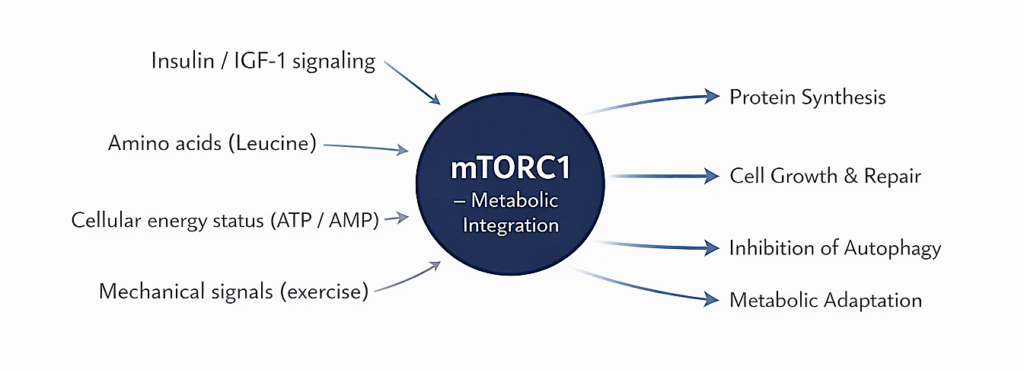
mTOR integrates insulin and nutrient signals → mTOR Signaling in Growth, Metabolism, and Disease
How Fasting and Movement Regulate mTOR and AMPK
When you go without food for a while — or when you exercise — a different system activates: AMPK.
AMPK signals:
- “Energy is low.”
- “Time to recycle damaged components.”
- “Time to improve efficiency.”
This is where:
- Autophagy happens (cellular cleanup)
- Insulin sensitivity improves
- Fat burning increases
- Mitochondria become healthier
It’s not a biohack.
It’s basic physiology that modern lifestyles suppress.
Without these repair windows, problems accumulate quietly for years — until suddenly someone is told:
“You now have type 2 diabetes.”
“You now have fatty liver.”
“Your metabolism seems to have collapsed.”
AMPK is a cellular energy sensor → AMP-activated protein kinase: a key regulator of energy balance with many roles in human disease
Why Protein Is Blamed for mTOR (But Insulin Is the Driver
Because:
- It’s easy to blame a single nutrient
- It sounds biochemical
- It fits neat narratives
- It avoids addressing lifestyle patterns
But blaming protein for chronic mTOR activation is like blaming bricks for a badly designed house.
Protein activates mTOR briefly after a meal.
That’s normal. That’s healthy. That’s necessary.
What drives chronic activation is persistent insulin signaling — driven by frequent eating, refined carbohydrates, and ultra-processed food.
That’s the distinction almost nobody explains.
What healthy physiology actually looks like
Healthy biology isn’t about suppressing pathways.
It’s about restoring rhythm.
It looks like:
- Eating real, nutrient-dense meals
- Allowing time between meals
- Not constantly snacking
- Moving your body regularly
- Sleeping properly
- Supporting insulin sensitivity
- Letting mTOR rise when appropriate
- Letting AMPK rise when appropriate
Growth and repair.
Day and night.
Inhale and exhale.
This is how physiology is designed.
The takeaway
You don’t need to fear protein.
You don’t need to suppress mTOR.
You don’t need to live in permanent restriction.
What you need is:
- Metabolic rhythm
- Fasting windows
- Movement
- Insulin sensitivity
- Real food
- Respect for biology instead of fear of biology
The problem isn’t that your body grows.
The problem is that it never gets time to repair.
The concepts discussed here are based on well-established research on mTOR, AMPK, insulin signaling, and metabolic physiology. For a detailed, fully referenced scientific analysis, see mTOR, AMPK, and Metabolic Signaling
Author bio
Morteza Ariana is a Functional Nutrition Practitioner specializing in insulin resistance, type 2 diabetes, and systems-based metabolic restoration. His work focuses on identifying upstream drivers of metabolic dysfunction — including insulin load, liver–gut axis disruption, circadian misalignment, and micronutrient gaps — rather than masking symptoms.
He works with high-performing professionals through a structured 12-week Metabolic Restoration Blueprint designed to restore metabolic flexibility and long-term resilience.
If this resonates, the next step is clarity.
The Metabolic Restoration Blueprint is a structured 12-week framework designed to correct upstream metabolic drivers — not just manage symptoms.