
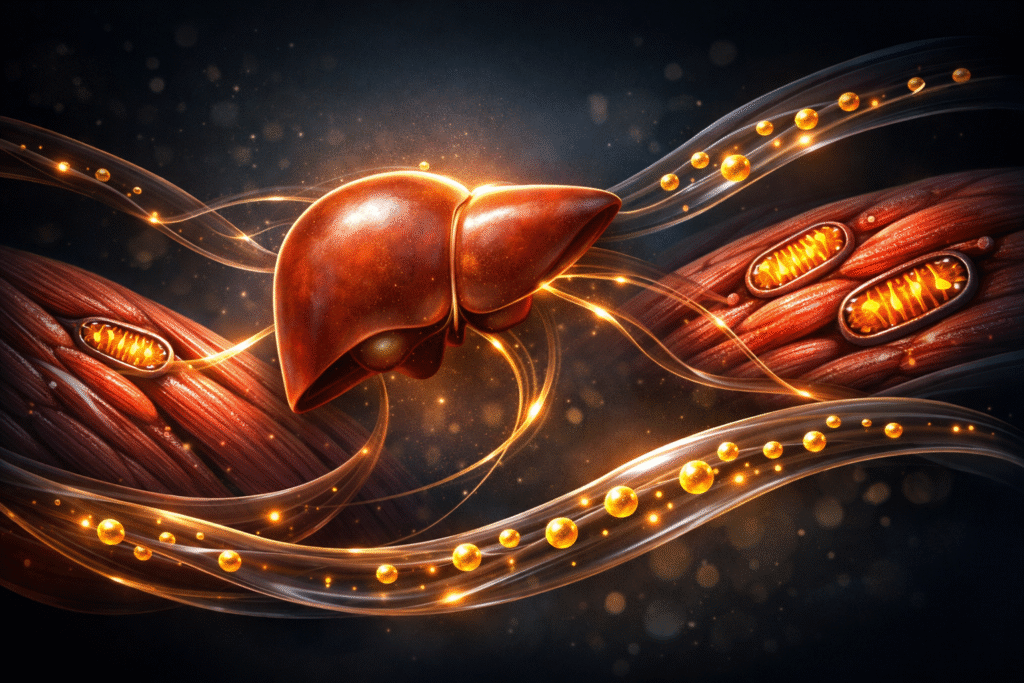
High triglycerides causes are almost universally misunderstood — by patients and by many doctors. If your triglycerides came back elevated on a blood test, you were probably told to eat less fat. That advice is not only wrong, it points you in the opposite direction from the real driver. Elevated triglycerides are primarily a carbohydrate and insulin problem, not a dietary fat problem — and understanding this distinction could change everything about how you approach your metabolic health.
Most people are told that elevated triglycerides simply mean they ate too much fat or too many calories. That explanation is neat, convenient—and biologically wrong.
Triglycerides are not a dietary fat problem. They are a metabolic signaling problem. When triglycerides rise, the body is telling a story about energy handling, hormonal signaling, mitochondrial capacity, liver function, and tissue communication. If you understand the story, you stop treating numbers—and start addressing root-cause physiology.
This article unpacks triglycerides through a systems-biology lens.
What triglycerides actually represent
Triglycerides are not inherently harmful. They are the body’s primary energy transport molecules. Fatty acids are packaged into triglycerides, placed into lipoproteins, and delivered to tissues that need fuel.
In a metabolically flexible human system:
- Triglycerides rise after meals → tissues absorb them efficiently
- Fasting levels remain low
- Muscles burn fat when needed
- The liver produces only what is required
Chronically elevated fasting triglycerides mean something very different:
The body is overproducing energy carriers because tissues cannot properly receive or utilize energy.
That is not a fat problem. That is an energy traffic problem.
The liver is not the villain—it’s responding to signals
When fasting triglycerides are elevated, the dominant source is usually hepatic VLDL overproduction, not dietary fat—a phenomenon classically described in the literature as carbohydrate‑induced hypertriglyceridemia. The liver packages triglycerides into very-low-density lipoproteins (VLDL) to export excess energy.
Why does the liver do this?
Because it is responding to upstream signals such as:
- Chronic hyperinsulinemia
- Excess carbohydrate flux (especially fructose)
- Glycogen overflow
- Impaired mitochondrial oxidation (low fat-burning capacity)
- Adipose tissue spillover (FFA overflow)
- Circadian disruption and poor sleep
- Stress hormone dominance
The liver is not malfunctioning. It is adapting.
High triglycerides are often the liver saying:
“Incoming energy exceeds storage and oxidation capacity. I must export this energy to protect the system.”
Insulin resistance drives triglyceride production
One of insulin’s lesser-known actions is its stimulation of de novo lipogenesis (DNL)—the conversion of excess carbohydrate into fatty acids within the liver.
Chronically elevated insulin (from frequent feeding, ultra-processed foods, refined carbohydrates, sleep disruption, stress physiology) drives:
- Increased hepatic lipogenesis
- Increased intrahepatic fat accumulation
- Increased VLDL secretion
- Elevated fasting triglycerides
This is why triglycerides are such a sensitive marker of metabolic dysfunction. They rise not because fat was consumed, but because the system is stuck in a glucose-dominant, insulin-saturated state with impaired fuel switching.
This also explains why triglycerides often improve rapidly with:
- Carbohydrate reduction
- Intermittent fasting
- Improved sleep timing and quality
- Resistance training
- Restoration of circadian rhythm
Not because fat is reduced—but because signaling is restored.
Fructose: a special case in triglyceride physiology
Fructose deserves separate attention because its metabolism is unique.
Unlike glucose, fructose is:
- Primarily metabolized in the liver
- Weakly regulated by satiety and insulin feedback
- Rapidly shunted toward lipogenesis when intake exceeds immediate needs
High hepatic fructose load (especially from juices, sweetened beverages, syrups, industrial foods) accelerates:
- Hepatic fat accumulation
- VLDL overproduction
- Triglyceride elevation
This is not an argument against whole fruit. Whole fruit behaves very differently from liquid fructose due to fiber, polyphenols, chewing, and dose. The dose, the matrix, and the metabolic context matter.
But the mechanism remains clear: excessive hepatic fructose flux pushes the liver toward triglyceride production.
Muscle: the forgotten triglyceride regulator
Skeletal muscle is the primary destination for both glucose and fatty acids. When muscle tissue is metabolically healthy:
- It absorbs circulating triglyceride-derived fatty acids efficiently
- It oxidizes fat during fasting and between meals
- It protects the liver from overload
When muscle is underdeveloped, sedentary, insulin resistant, or mitochondrially impaired:
- Fatty acid uptake declines
- Oxidative capacity decreases
- Lipid clearance slows
- Circulating triglycerides rise
This is why resistance training is not “fitness advice.” It is lipid physiology intervention.
Muscle mass and mitochondrial competence are among the strongest predictors of healthy triglyceride metabolism.
Mitochondria: when energy cannot be burned, it must be exported
Another major driver of elevated triglycerides is impaired mitochondrial function.
If cells cannot efficiently oxidize incoming fuel:
- Energy accumulates intracellularly
- Lipid intermediates rise
- The liver exports more triglycerides to prevent cellular toxicity
This explains why people with:
- Chronic fatigue
- Poor sleep architecture
- Micronutrient deficiencies
- Chronic sympathetic dominance
- Low physical activity
Often show elevated triglycerides even when calorie intake does not appear excessive.
The problem is not intake. It is energy utilization capacity.
Cortisol, sleep, and circadian disruption
Triglycerides are not only nutritional markers—they are neuroendocrine markers.
Sleep disruption and circadian misalignment lead to:
- Elevated evening cortisol
- Increased nocturnal glucose production
- Increased insulin exposure
- Increased hepatic lipogenesis
Clinically, it is common to see triglycerides normalize simply by correcting:
- Sleep timing
- Light exposure
- Late-night eating
- Chronic stress physiology
You cannot correct lipid physiology while ignoring circadian biology.
Biology does not compartmentalize.
The TG:HDL ratio reveals the real story
Triglycerides rarely exist in isolation. Their meaning becomes far clearer when interpreted alongside HDL.
A high TG:HDL ratio is strongly associated with:
- Insulin resistance
- Hepatic VLDL overproduction
- Impaired lipid clearance
- Reduced metabolic flexibility
A low ratio generally reflects efficient lipid trafficking, strong mitochondrial function, and metabolic resilience.
In practice, this ratio often signals metabolic dysfunction years before glucose, HbA1c, or formal diagnosis become abnormal.
That is not coincidence. That is physiology.
Why calorie-based explanations fail
The idea that triglycerides are simply a function of calorie excess is overly simplistic.
Two individuals can eat similar calories and exhibit completely different triglyceride responses depending on:
- Hormonal state
- Muscle mass
- Sleep quality
- Stress physiology
- Mitochondrial function
- Nutrient partitioning
- Gut–liver signaling
Calories describe energy quantity. They do not explain biological decision-making.
Metabolism is governed by signals, not arithmetic.
A brief clinical vignette
A 47-year-old professional presents with fasting triglycerides of 280 mg/dL. LDL-C is modest. BMI is only slightly elevated. Diet history reveals moderate calories, but frequent snacking, late dinners, poor sleep, high work stress, and minimal resistance training.
Rather than prescribing lipid suppression, the intervention focuses on:
- Consolidated eating window
- Improved sleep timing
- Resistance training 3× per week
- Reduction of refined carbohydrates and liquid sugars
- Restoration of circadian rhythm
Within three months, triglycerides fall to 120 mg/dL without medication. No calories were counted. No fat was restricted. The system was simply allowed to function again.
This pattern is not rare. It is predictable physiology.
The clinical takeaway
Elevated triglycerides are not a diagnosis. They are a metabolic clue.
They invite better questions:
- Is insulin chronically elevated?
- Is the liver overloaded?
- Is muscle functioning as a metabolic sink?
- Is sleep architecture intact?
- Is circadian rhythm aligned?
- Are mitochondria functioning optimally?
- Is the person metabolically flexible?
When these questions are addressed properly, triglycerides often normalize—not through suppression, but through restoration of biological function.
That is the difference between managing numbers and restoring health.
Final thought
Triglycerides are not enemies. They are messengers.
They reveal whether the body is thriving in metabolic harmony—or compensating for deeper dysfunction.
When you understand the message, you stop fearing the marker and start respecting the intelligence of the system.
And that is where real healing begins.
People Also Ask
What causes high triglycerides in the blood?
High triglycerides are most often caused by chronic insulin elevation, excess carbohydrate flux (especially refined carbs and liquid sugars), impaired liver fat handling, low muscle metabolic capacity, poor sleep, and reduced mitochondrial function. They are rarely caused by dietary fat alone.
Are triglycerides more important than LDL cholesterol?
Triglycerides provide powerful insight into metabolic health. Elevated triglycerides often reflect insulin resistance, fatty liver activity, and impaired energy utilization—sometimes years before LDL-C or glucose markers become abnormal.
What is a healthy TG:HDL ratio?
A lower TG:HDL ratio generally reflects better metabolic flexibility and insulin sensitivity. While exact cutoffs vary, ratios below ~2 (mg/dL units) are commonly associated with healthier metabolic function.
Can high triglycerides be reduced without medication?
In many cases, yes. Triglycerides often improve through restoring biological function: improving sleep, reducing refined carbohydrates, consolidating eating windows, increasing muscle mass through resistance training, and correcting circadian rhythm disruption.
Does eating fat raise triglycerides?
Dietary fat alone does not typically raise fasting triglycerides. Chronically elevated triglycerides are more strongly driven by excess insulin signaling, hepatic de novo lipogenesis, and impaired lipid clearance than by fat intake itself.
Why do triglycerides rise with poor sleep?
Sleep disruption increases cortisol and sympathetic signaling, alters glucose regulation, increases insulin exposure, and promotes hepatic fat production. Over time, this can lead to elevated triglycerides even without changes in diet.
Is fructose worse for triglycerides than glucose?
Fructose is preferentially metabolized in the liver and, when consumed in excess (especially in liquid or refined form), is more readily converted into triglycerides through de novo lipogenesis compared to glucose.
About the Author
Morteza Ariana is a State-Certified Functional Nutritionist based in Germany, specializing in insulin resistance, type 2 diabetes, and root-cause metabolic restoration. He holds advanced training in systems-based physiology and has worked with patients across the U.S. and Europe for over 10 years.
His clinical framework is built around a core principle that mainstream medicine consistently overlooks: chronically elevated insulin — not blood glucose — is the earliest and most actionable driver of metabolic disease. That conviction was shaped in part by his own experience with hyperinsulinemia in 2016, and deepened through a decade of clinical practice and the study of leading researchers in metabolic medicine including Benjamin Bikman, Joseph Kraft, Gerald Reaven, Jason Fung, and Stephen Phinney.
His work focuses on identifying and correcting the upstream metabolic signals — insulin load, liver-gut axis dysfunction, circadian misalignment, and micronutrient gaps — that standard screening misses entirely. Patient outcomes are documented, anonymized, and published on this site.
If this resonates, the next step is clarity
The Metabolic Restoration Blueprint is a structured 12-week framework designed to correct upstream metabolic drivers — not just manage symptoms.
Author bio
Morteza Ariana is a Functional Nutrition Practitioner specializing in insulin resistance, type 2 diabetes, and systems-based metabolic restoration. His work focuses on identifying upstream drivers of metabolic dysfunction — including insulin load, liver–gut axis disruption, circadian misalignment, and micronutrient gaps — rather than masking symptoms.
He works with high-performing professionals through a structured 12-week Metabolic Restoration Blueprint designed to restore metabolic flexibility and long-term resilience.
If this resonates, the next step is clarity
The Metabolic Restoration Blueprint is a structured 12-week framework designed to correct upstream metabolic drivers — not just manage symptoms.
Scientific References
- Samuel VT, Shulman GI. Mechanisms for insulin resistance: common threads and missing links. Cell. 2012
- Softic S, Cohen DE, Kahn CR. Role of dietary fructose and hepatic insulin resistance. Crit Rev Clin Lab Sci. 2017.
- Parks EJ, Hellerstein MK. Carbohydrate-induced hypertriacylglycerolemia: historical perspective and review. Am J Clin Nutr. 2000.
- Lambert JE et al. Increased de novo lipogenesis is a distinct characteristic of individuals with nonalcoholic fatty liver disease. Gastroenterology. 2014.
- Kelley DE, Mandarino LJ. Fuel selection in human skeletal muscle in insulin resistance. Diabetes. 2000.
- Schrauwen P, Hesselink MK. Oxidative capacity, lipotoxicity, and mitochondrial damage in type 2 diabetes. Diabetes. 2004.
- Spiegel K, Leproult R, Van Cauter E. Impact of sleep debt on metabolic and endocrine function. Lancet. 1999.
- Reaven GM. Role of insulin resistance in human disease. Diabetes. 1988.
- Petersen KF et al. Mitochondrial dysfunction in the elderly: possible role in insulin resistance. Science. 2003.