
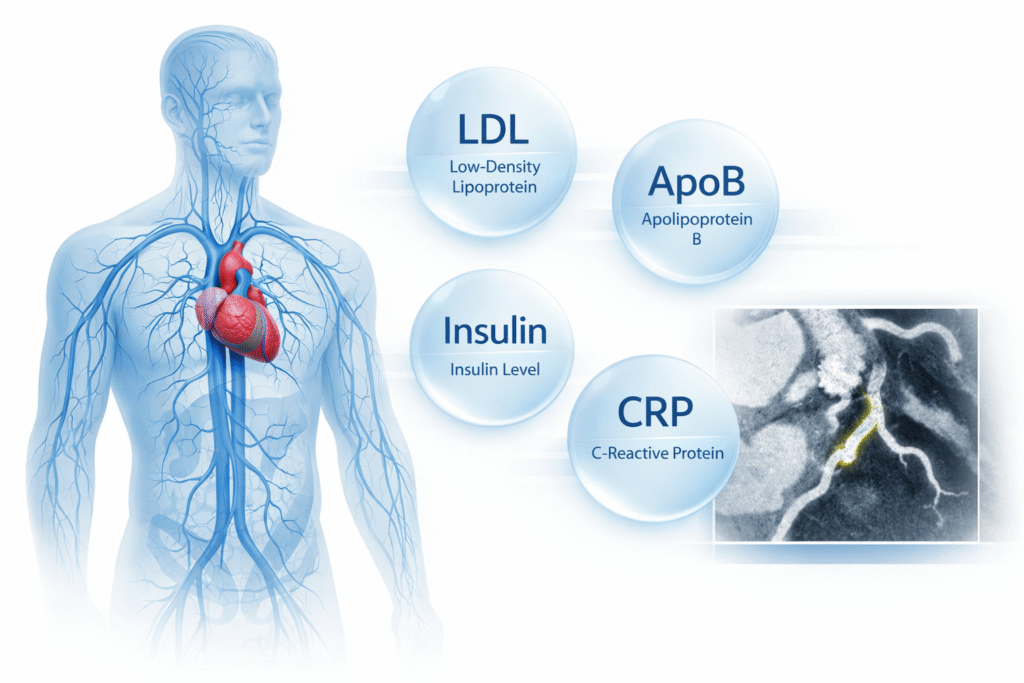
ApoB cholesterol risk is one of the most important conversations missing from routine cardiology appointments. If your doctor checked your LDL and told you it was fine, that number alone may be giving you a false sense of security — because LDL measures the amount of cholesterol carried in particles, while ApoB measures the number of particles themselves. And it is the particle count, not the cholesterol content, that determines how much damage is actually being done to your arteries.
A functional, systems-biology framework for lab assessment (Practitioner Reference Article)
Many people are told their “cholesterol risk” is defined by LDL-C or ApoB alone. In real physiology, atherosclerosis is a vascular-immune process, and lipoproteins are only one input. This article explains LDL vs ApoB, why they sometimes disagree, and how insulin resistance, inflammation, and imaging change interpretation.
Why LDL-C and ApoB deserve a more nuanced conversation
In real clinic life, “LDL/ApoB equals risk” often fails as a complete explanation.
You’ll see patients who:
- have high LDL-C / high ApoB but show minimal plaque on imaging, and remain stable over time,
- have “acceptable cholesterol” yet develop MI, stroke, or rapid plaque progression,
- or have conflicting signals (e.g., low TG/high HDL with high LDL, or high TG/low HDL with only mildly elevated LDL).
The key error in most lipid debates is reductionism:
Atherosclerosis is not a cholesterol problem.
It’s a vascular biology problem—with lipoproteins as one contributor inside a wider system.
A good interpretation framework must answer:
- What is the vascular environment (endothelium, inflammation, insulin signaling)?
- What is the metabolic environment (IR vs insulin sensitive)?
- What is the anatomical reality (plaque burden/character on CAC/CCTA)?
- Where do LDL-C and ApoB fit within that system?
What atherosclerosis is (physiology, not slogans)
Endothelial dysfunction is the gateway event
The endothelium is an active organ: it regulates nitric oxide, immune traffic, barrier permeability, and coagulation tone. When endothelial function is impaired, the artery becomes “sticky,” pro-inflammatory, and pro-thrombotic—conditions that allow atherosclerosis to develop and progress.
A major driver here is endothelial insulin resistance, which disrupts nitric oxide signaling and shifts vascular behavior toward dysfunction. This concept is explicitly highlighted in vascular biology commentary: endothelial insulin resistance is increasingly seen as causal in atherosclerosis progression.
Plaque is immune tissue with behavior
Plaque is not inert fat. It is immune-active tissue with macrophages, smooth muscle, cytokines, extracellular matrix remodeling, and thrombogenic potential.
Two patients with the same ApoB can have different trajectories depending on:
- inflammatory signaling,
- endothelial integrity,
- metabolic stress,
- blood pressure pulsatility,
- thrombosis biology,
- plaque composition.
Calcified vs non-calcified plaque: different meaning
CCTA studies show plaque type matters. In particular, low-attenuation noncalcified plaque burden has emerged as a strong predictor of myocardial infarction, often outperforming classical predictors (including stenosis severity) in stable chest pain populations (SCOT-HEART analysis).
Older CCTA work also identified “high-risk plaque” features—such as positive remodeling and low-attenuation plaque—as predictors of future acute coronary syndrome.
Clinical implication: lipid numbers cannot tell you plaque morphology. Imaging sometimes answers questions blood cannot.
Learn more how I assess scientific evidence
What LDL-C and ApoB can tell you (and what they cannot)
LDL-C vs ApoB
- LDL-C: cholesterol mass carried in LDL particles
- ApoB: number of atherogenic particles (LDL, VLDL remnants, IDL, Lp(a), etc.)
ApoB is often more informative in insulin resistance phenotypes where particle number rises disproportionately.
But the key is this:
ApoB and LDL-C are upstream descriptors of lipoprotein traffic.
Atherosclerosis is downstream vascular biology.
Why prediction fails in some contexts
ApoB can be strongly predictive in some populations and weak in others because of:
- Range restriction (if everyone has high ApoB, it won’t separate outcomes well),
- time horizon (12 months vs decades),
- heterogeneous biology (IR-driven atherosclerosis vs insulin-sensitive phenotypes),
- competing drivers (inflammation, thrombosis, BP, sleep apnea, etc.).
This is why intelligent interpretation requires context markers and (sometimes) imaging.
Risk factor ≠ treatment surrogate
This is one of the most important clinical distinctions, and it’s not “anti-anything”—it’s basic causal reasoning.
A biomarker can be associated with risk, yet still fail as a reliable trial-level surrogate for treatment benefit.
A 2025 umbrella review examining statin trials tested whether LDL-C and non-HDL-C reductions are valid trial-level surrogates for clinical outcomes. Their premise: if LDL lowering “causes” benefit in a clean way, trials with bigger LDL drops should consistently show bigger outcome gains. They found limited support for strong trial-level surrogacy.
This does not prove LDL is irrelevant. It does show that outcome biology is not captured by LDL change alone.
Similarly, a 2022 systematic review/meta-analysis (JAMA Internal Medicine) found that the absolute benefits of statins are modest and that outcomes may not be strongly mediated by the magnitude of LDL-C reduction.
Clinical implication: Do not tell patients “your LDL went down X therefore your risk dropped Y.” That’s not supported cleanly at the trial-level.
Imaging as the reality check (CAC and CCTA)
CAC predicts events strongly
In MESA (multi-ethnic cohort), coronary calcium powerfully predicted coronary events, and adding CAC improved discrimination beyond standard risk factors.
This is why CAC is often more clinically clarifying than endless arguments about risk calculators and single markers.
CCTA plaque characteristics add another layer
CCTA does more than “stenosis.” It describes plaque composition and features associated with risk:
- low-attenuation plaque burden predicting MI (SCOT-HEART analysis)
- remodeling/low-attenuation plaque predicting future ACS
Clinical implication: imaging is not “for everyone,” but it’s highly relevant when lipid markers are discordant with phenotype or family history, or when clinical uncertainty persists.
The KETO-CTA longitudinal data (why it matters for LDL-C and ApoB debates)
The KETO-CTA longitudinal paper followed ~100 participants with an LMHR or near-LMHR phenotype over one year using high-resolution CCTA/CAC.
Headline result:
- Baseline plaque predicted progression (“plaque predicts plaque”)
- LDL-C and ApoB did not predict progression over that short interval
Here’s the clinically mature takeaway:
- This does not prove ApoB is useless.
- It does demonstrate that in a metabolically distinct phenotype and short time window, existing arterial disease burden dominates prediction.
- It supports a practical rule: When uncertainty is high and phenotype is atypical, anatomy can outperform blood markers.
The insulin resistance axis (why metabolic context dominates risk biology)
Endothelial insulin resistance is not a footnote
Endothelial insulin resistance is increasingly recognized as a causal contributor in atherosclerosis: impaired insulin signaling in endothelial cells reduces nitric oxide and shifts vessels toward dysfunction.
Diabetes risk is vascular biology, not just “sugar”
Diabetes and insulin resistance amplify oxidative stress, inflammation, glycation, and endothelial impairment. Broad cardiometabolic prevention literature consistently frames diabetes as a powerful accelerator of ASCVD risk.
Statins and insulin resistance: a tradeoff worth knowing
This is not about fear. It’s about accurate counseling and individualized risk tradeoffs.
- A 2010 Lancet collaborative meta-analysis of randomized statin trials found statin therapy was associated with a modestly increased risk of incident diabetes.
- A 2021 clinical trial showed high-intensity atorvastatin increased insulin resistance and insulin secretion in people without baseline T2D over 10 weeks.
- An accompanying editorial argued that new-onset diabetes risk appears driven by increased insulin resistance.
Clinical implication: Metabolic phenotype matters. In insulin-resistant patients, tradeoffs may differ than in insulin-sensitive phenotypes.
Lp(a): the “modifier” that changes thresholds
Lp(a) is one of the most important reasons simplistic LDL/ApoB interpretations fail. Many people with normal LDL-C still have high risk because Lp(a) adds particle burden and pro-atherothrombotic signaling.
The 2022 European Atherosclerosis Society consensus statement provides clinical guidance on testing and emphasizes its role in ASCVD and aortic valve stenosis risk.
Clinical implication: In ambiguous cases, Lp(a) can explain “why the story doesn’t make sense.”
Vascular calcification and vitamin K–dependent biology
Atherosclerosis and calcification are regulated processes, not passive “clogging.” Vitamin K–dependent proteins such as matrix Gla protein (MGP) are involved in calcification regulation, and K2-related biology is often discussed in this context.
Important: vitamin K2 is not a magic solution; human outcome data are mixed and context-dependent. The point is that calcification biology isn’t captured by LDL alone.
Mevalonate pathway biology: why “lower cholesterol” is not the whole story
Statins inhibit HMG-CoA reductase, reducing mevalonate pathway products—not only cholesterol. Basic science shows mevalonate pathway disruption affects cellular processes such as DNA and protein synthesis regulation.
Mechanistic studies also show statin-related oxidative and antioxidant-system perturbations in muscle cell models, including suppression of selenoprotein biosynthesis under certain conditions.
Clinical implication: These pathway realities help explain why individuals vary in tolerance and why a “one size fits all” narrative is incomplete.
A practical functional framework for lab interpretation
Step 1 — Define metabolic phenotype first
Anchor with:
- fasting glucose, HbA1c
- fasting insulin (or C-peptide)
- triglycerides, HDL-C (TG/HDL pattern)
- ALT/AST (NAFLD hint), waist circumference
- blood pressure and sleep quality (OSA risk)
Interpretation rule:
See TG:HDL pattern
- Insulin resistance phenotype = higher likelihood that ApoB reflects genuine atherogenic particle overproduction and endothelial stress
- Insulin sensitive phenotype = ApoB/LDL may be less predictive alone → consider modifiers and imaging
Step 2 — Define inflammatory and vascular stress context
Anchor with:
- hs-CRP (plus clinical context)
- ferritin with iron studies
- oral health / sleep / visceral fat
- resting HRV if available
Inflammation correlates with vascular risk and can reframe lipid interpretation.
Step 3 — Interpret ApoB/LDL within the above context
ApoB high in insulin resistance: usually meaningful (particle excess + hostile endothelium).
ApoB high in LMHR-like phenotype: interpret with caution; consider anatomy and modifiers (Lp(a), family history).
Step 4 — Decide whether anatomy is needed
Imaging is particularly useful when:
- phenotype is metabolically healthy but ApoB/LDL very high
- family history suggests discordance
- symptoms exist
- risk narrative is unclear and patient needs clarity
CAC has strong event prediction value.
CCTA adds plaque morphology (risk biology).
Decision-tree patterns you can reuse in every lab assessment
Pattern A — Insulin resistant phenotype (highest actionable yield)
Typical:
- TG high, HDL low, fasting insulin high
- ApoB often high
Approach: - treat insulin resistance, liver fat, sleep apnea risk, inflammation drivers
- ApoB tends to track risk meaningfully here
Pattern B — LMHR-like/“metabolically healthy but high ApoB/LDL”
Typical:
- TG low, HDL high, good glycemia, high LDL/ApoB
Approach: - do not assume “safe” or “dangerous” based on lipids alone
- check Lp(a), inflammatory context, family history
- consider CAC/CCTA to resolve uncertainty
Pattern C — Inflammatory phenotype
Typical:
- hs-CRP elevated, ferritin elevated, chronic stress/sleep fragmentation
Approach: - interpret ApoB/LDL with caution; inflammation may dominate plaque behavior
Pattern D — Lp(a)/genetic risk phenotype
Typical:
- strong family history, elevated Lp(a), early events in family
Approach: - thresholds shift; “normal” LDL may not mean low risk
Key takeaways
- LDL-C measures cholesterol mass; ApoB measures atherogenic particle number.
- Discordance is common in insulin resistance and hypertriglyceridemia.
- Inflammation, endothelial biology, and thrombosis can dominate risk.
- CAC/CCTA can clarify risk when markers are discordant or history is strong.
- Interpretation should start with metabolic phenotype, not isolated numbers.
What we know, what we don’t, and how to stay honest
What is strong
- CAC strongly predicts events and improves risk discrimination.
- Plaque morphology on CCTA predicts MI/ACS risk.
- Metabolic dysfunction and endothelial insulin resistance plausibly drive atherosclerosis biology.
- Lp(a) is a major risk modifier supported by consensus guidance.
What remains uncertain (and we should admit it)
- Long-term outcomes for sustained high ApoB in insulin-sensitive LMHR-like phenotypes are not definitively established.
- Trial-level analyses show LDL change is not a clean surrogate for benefit in statin trials, but this does not “disprove” lipoprotein causality; it shows multi-pathway outcome biology.
Honesty about uncertainty is not weakness—it’s clinical strength.
About the Author
Morteza Ariana is a State-Certified Functional Nutritionist based in Germany, specializing in insulin resistance, type 2 diabetes, and root-cause metabolic restoration. He holds advanced training in systems-based physiology and has worked with patients across the U.S. and Europe for over 10 years.
His clinical framework is built around a core principle that mainstream medicine consistently overlooks: chronically elevated insulin — not blood glucose — is the earliest and most actionable driver of metabolic disease. That conviction was shaped in part by his own experience with hyperinsulinemia in 2016, and deepened through a decade of clinical practice and the study of leading researchers in metabolic medicine including Benjamin Bikman, Joseph Kraft, Gerald Reaven, Jason Fung, and Stephen Phinney.
His work focuses on identifying and correcting the upstream metabolic signals — insulin load, liver-gut axis dysfunction, circadian misalignment, and micronutrient gaps — that standard screening misses entirely. Patient outcomes are documented, anonymized, and published on this site.
If this resonates, the next step is clarity
The Metabolic Restoration Blueprint is a structured 12-week framework designed to correct upstream metabolic drivers — not just manage symptoms.
Scientific References
Key sources
- Detrano R, et al. NEJM 2008… PMID: 18367736
- KETO-CTA (JACC Advances, 2025)
- MESA CAC (NEJM, 2008)
- SCOT-HEART plaque (Circulation, 2020)
- LDL surrogate paper (PMID 39999862)
Endothelial function, insulin resistance, mechanisms
- Kanter JE, Bornfeldt KE.
Do Endothelial Cells and Macrophages in Atherosclerosis Rely on Insulin Signaling?
Circulation Research. 2013;113(9):1084–1097.
PMID: 23908326 - Dal Canto E, Ceriello A, Rydén L, et al.
Diabetes as a cardiovascular risk factor: An overview of epidemiology and clinical evidence.
European Journal of Preventive Cardiology. 2019;26(2_suppl):25–33.
PMID: 31722562 - Fuhrmeister J, Hanf R, Schmidt M, et al.
Statin-induced myotoxicity is associated with mitochondrial dysfunction and reduced selenoprotein biosynthesis.
Toxicology Letters. 2012;211(3):299–305.
PMID: 23092657 - Sinensky M, Logel J, Hahn D, et al.
Inhibition of isoprenoid biosynthesis by compactin results in inhibition of DNA synthesis in mammalian cells.
Proceedings of the National Academy of Sciences (PNAS). 1985;82(10):3257–3261.
PMID: 2582409
Imaging, plaque, CAC, CCTA
- Detrano R, Guerci AD, Carr JJ, et al.
Coronary Calcium as a Predictor of Coronary Events in Four Racial or Ethnic Groups.
New England Journal of Medicine. 2008;358:1336–1345.
PMID: 18367736 - Williams MC, Kwiecinski J, Doris M, et al.
Low-Attenuation Noncalcified Plaque on Coronary Computed Tomography Angiography Predicts Myocardial Infarction.
Circulation. 2020;141(18):1452–1462.
PMID: 32114860 - Motoyama S, Kondo T, Sarai M, et al.
Multislice Computed Tomographic Characteristics of Coronary Lesions in Acute Coronary Syndromes.
Journal of the American College of Cardiology. 2007/2009 series.
Classic predictive paper: JACC 2009;54(1):49–57.
PMID: 19555840 - Budoff MJ, Shaw LJ, Liu ST, et al.
Long-term prognosis associated with coronary calcification: Observations from a registry of 25,253 patients.
Journal of the American College of Cardiology. 2007.
PMID: 17394963
KETO-CTA
- Norwitz NG, Feldman D, et al.
Longitudinal Data From the KETO-CTA Study: Plaque Predicts Plaque, ApoB Does Not.
JACC: Advances. 2025.
DOI: 10.1016/j.jacadv.2025.101686
(This is the study you linked directly.)
Surrogate marker and statin outcome interpretation
- [PMID 39999862]
Umbrella review of statin trials examining whether LDL-C and non-HDL-C are valid trial-level surrogates for cardiovascular outcomes.
Publication year: 2024/2025 (PubMed indexed).
PMID: 39999862 - Byrne P, Cullinan J, Smith SM.
Evaluating the Association Between LDL-C Reduction and the Relative and Absolute Effects of Statin Treatment: A Systematic Review and Meta-analysis.
JAMA Internal Medicine. 2022;182(5):474–483.
PMID: 35285850 - Sattar N, Preiss D, Murray HM, et al.
Statins and risk of incident diabetes: A collaborative meta-analysis of randomized statin trials.
The Lancet. 2010;375(9716):735–742.
PMID: 20167359
LDL skepticism / alternative interpretation literature (used cautiously in article)
- Kendrick M.
Assessing cardiovascular disease risk: looking beyond cholesterol.
Current Opinion in Endocrinology, Diabetes and Obesity. 2022;29(5):401–407.
PMID: 35938775 - Ravnskov U, Diamond DM, Hama R, et al.
Lack of an association or an inverse association between LDL cholesterol and mortality in the elderly: A systematic review.
BMJ Open. 2016;6:e010401.
PMID: 27292972 - Ravnskov U, Diamond DM, Kendrick M, et al.
LDL-C does not cause cardiovascular disease: a comprehensive review of current literature.
Expert Review of Clinical Pharmacology. 2018;11(10):959–970.
PMID: 30198808
(In the article we treat these as critical/challenging papers, not as definitive proof.)
Lp(a)
- Tsimikas S, Stroes ESG.
The dedicated “Lp(a) clinic”: A concept whose time has arrived?
European Heart Journal. 2020.
PMID: 32020148 - Kronenberg F, Mora S, Stroes ESG, et al.
Lipoprotein(a) in atherosclerotic cardiovascular disease and aortic valve stenosis: a European Atherosclerosis Society consensus statement.
European Heart Journal. 2022;43(39):3925–3946.
DOI: 10.1093/eurheartj/ehac361
TG/HDL and metabolic phenotype
- Bittner V, Johnson BD, Zineh I, et al.
The triglyceride/high-density lipoprotein cholesterol ratio predicts all-cause mortality in women with suspected myocardial ischemia.
American Heart Journal. 2009;157(3):548–555.
PMID: 19249425 - Reaven GM.
Insulin resistance and coronary heart disease.
New England Journal of Medicine. 1988;319:1157–1163.
PMID: 3054554
Vitamin K and vascular calcification
- El Asmar MS, Naoum JJ, Arbid EJ.
Vitamin K dependent proteins and the role of vitamin K2 in the modulation of vascular calcification.
Oman Medical Journal. 2014;29(3):172–177.
PMID: 24936265 - Lees JS, Chapman FA, Witham MD, et al.
Vitamin K supplementation for the prevention of cardiovascular disease: systematic review and meta-analysis.
BMJ Open. 2019.
PMID: 31462552
Aging cohorts / context beyond lipids
- van Peet PG, de Craen AJM, Gussekloo J, et al.
Is high total cholesterol associated with longer survival in older persons?
Journal of the American Geriatrics Society. 2005.
PMID: 16078957 - Willems JM, Trompet S, Blauw GJ, et al.
NT-proBNP predicts cardiovascular events and mortality in older persons.
Journal of the American College of Cardiology. 2010.
PMID: 20117403
Optional additions (if you want to make it even stronger later)
These are commonly used anchor papers in serious cardiometabolic discussions:
- Libby P.
Inflammation in Atherosclerosis.
Nature. 2002;420:868–874.
PMID: 12490960 - Ridker PM, Rifai N, Rose L, et al.
Comparison of CRP and LDL-C in the prediction of first cardiovascular events.
New England Journal of Medicine. 2002.
PMID: 11923403