
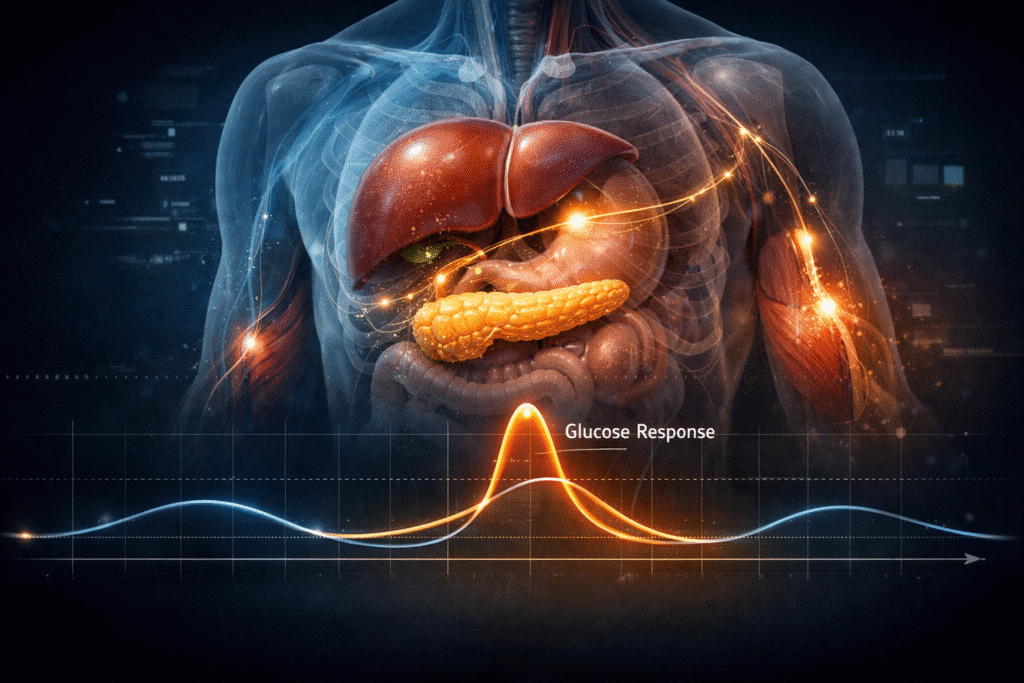
A blood sugar spike after eating is one of the earliest warning signs of insulin resistance — and it is almost never caught by standard fasting labs. If your doctor tells you your blood sugar is fine but you feel exhausted after meals, experience afternoon brain fog, or crave something sweet within an hour of eating, this article explains exactly what is happening in your metabolism.
Most metabolic testing happens in a fasted state.
You wake up.
You skip breakfast.
You sit quietly.
Blood is drawn.
And you are told:
“Your glucose is normal.”
But metabolism does not happen in a fasted state.
It happens after meals.
When post-meal glucose spikes occur while fasting labs remain normal, it often signals early insulin resistance rather than healthy metabolism.
Fasting Glucose Is a Resting Snapshot
Fasting glucose tells you how your body regulates blood sugar in the absence of incoming fuel.
It reflects:
- Basal insulin activity
- Hepatic glucose output
- Overnight metabolic stability
It does not tell you how your body handles:
- Carbohydrate load
- Mixed meals
- Fructose exposure
- Stress during digestion
- Real-world eating patterns
Fasting glucose is useful.
But it is incomplete.
What Happens After You Eat
After a meal, glucose rises.
In metabolically flexible individuals:
- Glucose rises modestly
- Insulin rises appropriately
- Glucose returns to baseline efficiently
- Energy is distributed smoothly
In early metabolic dysfunction:
- Glucose rises higher
- Insulin rises more aggressively
- Clearance slows
- Post-meal fatigue appears
And yet — fasting labs may still look perfect.
Why Spikes Appear Before Fasting Abnormalities
The body prioritizes fasting stability.
It will compensate aggressively to protect fasting glucose.
But post-meal regulation is more demanding.
It requires:
- Rapid insulin secretion
- Efficient muscle uptake
- Flexible liver response
- Adequate mitochondrial function
When tissues begin losing sensitivity, the first cracks often appear after meals — not in the fasted state.
This is not speculation.
It is physiology.
The Liver’s Role in Post-Meal Spikes
The liver acts as a buffer.
After eating, it must:
- Absorb glucose
- Suppress endogenous glucose production
- Manage triglyceride synthesis
When hepatic insulin resistance develops:
- Glucose output may not shut down efficiently
- Post-meal glucose may remain elevated longer
- Triglycerides may rise disproportionately
Subtle increases in ALT and GGT may begin drifting upward during this phase. This often precedes elevated fasting glucose.
Which is why relying on fasting labs alone can be misleading.
Post-Meal Spikes and Insulin Resistance
Early insulin resistance does not always show up as high fasting glucose.
It often shows up as:
- Higher peaks after meals
- Slower return to baseline
- Increased variability
Fasting insulin may already be elevated.
HOMA-IR may be drifting upward.
ALT or GGT may be subtly rising.
But fasting glucose? Still “normal.”
This is the compensation phase.
And compensation has limits.
Why HbA1c Can Still Look Fine
HbA1c reflects average glucose exposure.
If post-meal spikes are brief but repeated:
- The average may remain acceptable
- The variability may be invisible
- The stress may accumulate silently
Two people can share the same HbA1c:
- One with stable glucose curves
- One with repeated sharp peaks and crashes
The average hides the pattern.
Metabolism responds to patterns.
This is why relying on fasting insulin vs HbA1c alone can miss early instability in real-world metabolism.
Symptoms Often Appear Here First
Many people notice:
- Fatigue 60–90 minutes after eating
- Brain fog
- Cravings soon after meals
- Irritability
- Sudden hunger
These are not character flaws.
They are metabolic signals.
Post-meal instability often precedes fasting instability by years.
Ignoring that window delays intervention.
Continuous Glucose Monitoring Changed the Conversation
The availability of continuous glucose monitors (CGMs) has exposed something important:
Many individuals with “normal” fasting glucose exhibit exaggerated post-meal excursions.
This does not mean everyone needs a CGM.
But it does reveal a truth:
Metabolic dysfunction is dynamic.
Static labs cannot capture dynamic instability.
When Post-Meal Spikes Matter Most
Post-prandial dysregulation becomes especially relevant when:
- Fasting glucose is normal
- HbA1c is normal
- Fasting insulin is elevated
- HOMA-IR is rising
- TG:HDL ratio is worsening
- ALT and GGT are drifting upward
This cluster signals early metabolic strain — even before diagnostic thresholds are crossed.
Waiting for fasting glucose to rise means waiting for compensation to fail.
The Myth of “As Long As My Fasting Is Fine”
This belief persists because guidelines emphasize:
- Diabetes diagnosis
- Fasting thresholds
- Population cutoffs
But metabolic resilience is not defined by minimum thresholds.
It is defined by flexibility.
The ability to:
- Handle a meal
- Recover efficiently
- Avoid excessive insulin demand
- Maintain energy stability
That is real metabolic health.
This Is Not About Fear of Carbohydrates
Post-meal spikes are not a moral judgment about food.
They are feedback about metabolic capacity.
In insulin-sensitive individuals, moderate carbohydrate loads are handled smoothly.
In insulin-resistant individuals, the same meal produces greater strain.
The difference is context.
Not ideology.
The Bigger Pattern
If fasting labs are normal but post-meal spikes are exaggerated, the body is compensating.
And the question becomes:
How long can it sustain that compensation?
Early metabolic dysfunction is often most visible in the fed state.
That is why fasting labs can look normal while physiology is already shifting.
Ultimately, exaggerated post-meal spikes reflect insulin resistance as the central metabolic failure long before diagnostic thresholds are crossed.
What to Do If You Suspect Post-Meal Instability
The goal is not to obsess over glucose curves.
The goal is to understand:
- Whether insulin demand is excessive
- Whether liver handling is impaired
- Whether metabolic flexibility is declining
That requires interpretation.
Not isolated metrics.
If you want a structured evaluation that integrates fasting insulin, HOMA-IR, liver markers, lipid patterns, and dynamic responses — rather than relying on one reassuring fasting number — you have the option to work with me through a Clinical Metabolic Assessment — interpretation before intervention.
Because post-meal instability is often reversible.
But only if addressed before compensation fails.
People Also Ask
Are post-meal glucose spikes normal?
Mild rises after eating are normal. Large or prolonged spikes may indicate reduced insulin sensitivity or metabolic strain.
Can fasting glucose be normal while post-meal spikes are high?
Yes. Early insulin resistance often appears first in post-meal responses before fasting values change.
What level is considered a spike?
Sustained elevations above typical post-meal ranges or delayed return to baseline may indicate reduced metabolic flexibility.
About the Author
Morteza Ariana is a State-Certified Functional Nutritionist based in Germany, specializing in insulin resistance, type 2 diabetes, and root-cause metabolic restoration. He holds advanced training in systems-based physiology and has worked with patients across the U.S. and Europe for over 10 years.
His clinical framework is built around a core principle that mainstream medicine consistently overlooks: chronically elevated insulin — not blood glucose — is the earliest and most actionable driver of metabolic disease. That conviction was shaped in part by his own experience with hyperinsulinemia in 2016, and deepened through a decade of clinical practice and the study of leading researchers in metabolic medicine including Benjamin Bikman, Joseph Kraft, Gerald Reaven, Jason Fung, and Stephen Phinney.
His work focuses on identifying and correcting the upstream metabolic signals — insulin load, liver-gut axis dysfunction, circadian misalignment, and micronutrient gaps — that standard screening misses entirely. Patient outcomes are documented, anonymized, and published on this site.
If this resonates, the next step is clarity
The Metabolic Restoration Blueprint is a structured 12-week framework designed to correct upstream metabolic drivers — not just manage symptoms.
Scientific References
Postprandial Hyperglycemia Is an Important Glycemic Target
Post-meal (postprandial) hyperglycemia contributes to vascular risk and is a key component of overall glycemic control. PubMed
Meal Sequence Affects Post-Meal Glucose and Insulin
Randomized trial showing that food order significantly alters post-prandial glucose and insulin responses, highlighting the dynamic nature of post-meal regulation. Diabetes Care
Continuous Glucose Monitoring Reveals Post-Meal Spikes in Healthy People
CGM studies show considerable variability in post-prandial glucose excursions even among otherwise healthy individuals and link those spikes to metabolic signals. Metabolism
Review of Diet, Lifestyle, and Post-Meal Glycemia
Comprehensive review of how meal composition, timing, and lifestyle affect post-prandial glucose responses and insulin resistance. PubMed