
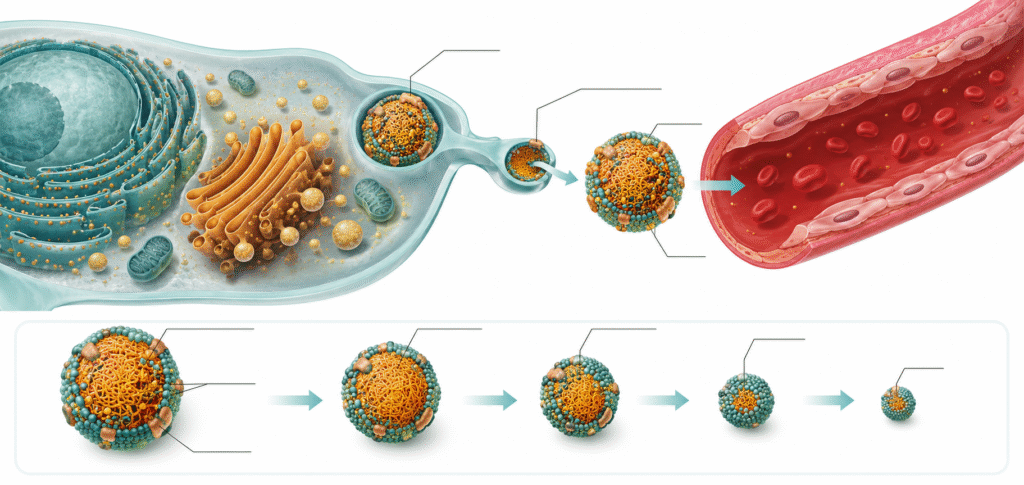
VLDL metabolism: the liver packages triglyceride into VLDL particles that are progressively converted into LDL as they travel through circulation.
A triglyceride level of 220 mg/dL tells a patient almost nothing on its own. It’s a number on a page, usually followed by generic advice to eat less fat or sugar. What it actually represents is a snapshot of a process — the liver packaging up excess fat and shipping it into the bloodstream faster than the rest of the body can clear it. Understanding that process, VLDL metabolism, is what turns a triglyceride number from a warning label into a diagnosis.
VLDL — very-low-density lipoprotein — is the particle the liver uses to export fat. It’s also the parent particle of LDL: every LDL molecule in your blood started life as VLDL before being stripped down through circulation, a pathway already covered in LDL particle physiology. This piece goes one level upstream, to the liver itself: what determines how much VLDL it makes, why insulin resistance turns this normal export system into an overproduction problem, and why that overproduction is the real event behind both high triglycerides and small, dense LDL.
What You Will Learn
- What VLDL is and why the liver makes it in the first place
- The two raw materials that feed VLDL production, and where they come from
- How insulin normally controls VLDL output — and how insulin resistance breaks that control
- Why liver fat itself becomes a self-sustaining driver of VLDL overproduction
- What determines whether a VLDL particle gets fully cleared or ends up reshaped into small, dense LDL
- Why a single triglyceride number can have very different underlying causes
What VLDL Is For
The liver is constantly handling fat — fat arriving from the diet, fat arriving from body fat stores, and fat the liver makes itself. Some of that fat gets burned for energy, some gets stored temporarily as liver fat, and the rest has to go somewhere else in the body. VLDL is the vehicle built for that last job: exporting triglyceride-rich fat out of the liver and into the bloodstream, where muscle and fat tissue can take it up.
Structurally, a VLDL particle looks a lot like the LDL particle it will eventually become — a shell of phospholipid and free cholesterol wrapped around a core, with one molecule of apolipoprotein B-100 anchoring the whole structure together, the same apoB-100 that carries both the LDL-receptor binding site and the proteoglycan-binding site discussed in the earlier posts in this cluster. The difference at this stage is the core: a freshly made VLDL particle is built mostly of triglyceride, with comparatively little cholesteryl ester. It’s a fat-delivery truck, not a cholesterol-delivery truck — the cholesterol-heavy identity comes later, after the fat has been unloaded.
The Two Sources That Fill the Tank
VLDL production isn’t a single tap the liver turns on or off. It depends on how much fat is arriving at the liver in the first place, and that fat comes from two distinct sources.
The first source is fat arriving from outside the liver — mainly free fatty acids released from body fat stores through lipolysis, and to a smaller degree, fat delivered directly from the gut after a meal. Normally, insulin suppresses this release: after eating, insulin tells fat tissue to stop breaking down stored fat and start storing more. When that suppression works properly, the liver only receives a modest, well-regulated fatty acid supply.
The second source is fat the liver makes itself, a process called de novo lipogenesis — literally, “new fat from scratch.” The liver can convert excess carbohydrate and other substrates into new fatty acids internally, independent of anything arriving from outside. Isotope-tracing studies in patients with fatty liver disease have shown that both of these sources — fat spilling in from body stores and fat synthesized internally — are major contributors to the triglyceride the liver ends up either storing or exporting as VLDL, with de novo lipogenesis making a disproportionately large contribution in people who already have excess liver fat.
Under normal metabolic conditions, these two supply lines are tightly regulated by insulin, and VLDL output stays proportionate to what the body actually needs to move. The problem starts when that regulation fails.
How Insulin Resistance Disrupts Normal VLDL Metabolism
This is the mechanism that separates ordinary VLDL production from the overproduction pattern seen in insulin resistance, and it involves insulin doing two contradictory things in two different tissues at once — a state researchers have called selective hepatic insulin resistance.
In healthy adipose tissue, insulin’s job after a meal is to shut down lipolysis — to stop fat cells from releasing fatty acids into the blood. In insulin-resistant fat tissue, that suppression fails. Fat cells keep leaking fatty acids into circulation even when insulin is high, and a larger share of that fatty acid flow heads straight to the liver.
At the same time, inside the liver itself, insulin resistance doesn’t uniformly shut down insulin’s effects — it does something more specific. The pathway insulin normally uses to suppress VLDL secretion becomes resistant, while the pathway insulin uses to stimulate new fat synthesis (de novo lipogenesis) often remains intact or is even amplified.
The practical result: the liver keeps making new fat in response to insulin, while losing insulin’s ability to tell it not to package and export that fat as VLDL. Direct kinetic studies using isotope tracers have confirmed this pattern clinically — insulin normally suppresses the largest, most triglyceride-rich VLDL particles (called VLDL1) after eating, but in people with high liver fat, that suppression is lost, and VLDL1 secretion continues unchecked.
So the liver ends up with more incoming fat from adipose tissue, more self-generated fat from lipogenesis, and a broken brake pedal on the export process that would normally hold VLDL output in check. All three push in the same direction: more triglyceride-rich VLDL particles leaving the liver.
Liver Fat as Both a Symptom and a Driver
One detail changes how this should be understood clinically: liver fat content itself, independent of blood glucose or diagnosed diabetes, is one of the strongest direct predictors of how much VLDL the liver is overproducing. In controlled kinetic studies comparing people across a range of liver fat levels, liver fat content and plasma glucose together explained the majority of the variation in VLDL1 production — more so than insulin levels, waist circumference, or other markers measured in the same patients.
This matters because it reframes the relationship between fatty liver and dyslipidemia. Fatty liver isn’t just a downstream consequence sitting alongside high triglycerides — it is mechanistically upstream of them. A liver already accumulating fat has more raw material sitting right there, ready to be packaged into VLDL, which is part of why the two conditions travel together so consistently and why addressing insulin resistance and hepatic fat tends to move triglycerides even before major weight change occurs.
From VLDL to LDL: Where the Overproduction Problem Resurfaces
Once a VLDL particle leaves the liver, its fate depends on what happens next in circulation — a process covered step by step in the earlier post on LDL particle physiology: lipoprotein lipase strips out triglyceride as the particle travels through muscle and fat tissue, the particle shrinks and grows denser, and if that process runs to completion, it ends up as LDL.
The overproduction pattern described above changes that pathway in a specific, measurable way. When the liver is exporting unusually triglyceride-rich VLDL1 particles at a high rate, the downstream conversion process produces disproportionately more small, dense LDL — the exact particle subtype shown in the LDL physiology post to bind arterial proteoglycans more readily and circulate longer before clearance. This isn’t a coincidence or a separate problem sitting next to high triglycerides; it’s the same overproduction event showing up twice, once as an elevated triglyceride number and once, downstream, as a shift in LDL particle character that a standard LDL cholesterol test won’t capture on its own — which is exactly the discordance problem discussed in that earlier post.

Clinical Perspective: What I See in Practice
When I see triglycerides of 220 mg/dL, I do not simply think, “This patient has high triglycerides.” Instead, I ask: why is the liver exporting so much triglyceride in the first place?
In many patients, this pattern begins with insulin resistance and excess energy accumulating in the liver. Insulin resistance often develops alongside visceral fat accumulation. As a result, adipose tissue becomes less effective at suppressing lipolysis, so more free fatty acids are released and delivered to the liver. At the same time, excess carbohydrate and energy can contribute to de novo lipogenesis. If hepatic insulin resistance is present, the liver may continue producing and packaging triglycerides despite already having abundant energy. In some patients, alcohol can further increase hepatic triglyceride synthesis.
The liver therefore has an excess supply of fatty acids and triglycerides. To deal with this surplus, it packages triglycerides into VLDL particles and releases them into the bloodstream. Thus, a triglyceride value of 220 mg/dL may be the visible downstream signal of an upstream problem: the liver is receiving, producing, and exporting more fat than the metabolic system is efficiently handling.
This changes the clinical conversation. Instead of simply saying, “Your triglycerides are high, avoid fatty foods,” I explain: your triglycerides are elevated because your liver is likely exporting an increased amount of triglyceride-rich VLDL. Now we need to understand why. Is the main driver insulin resistance? Liver fat? Excess alcohol? Persistent caloric surplus? Poor glycemic control? Or a combination of these?
This distinction matters because the triglyceride number itself is not the root cause. It is a biomarker reflecting the balance between triglyceride production, VLDL secretion, and triglyceride clearance. The clinical goal, therefore, is not simply to push the number down. It is to identify what is driving the excess VLDL production or impaired clearance and address that upstream physiology.
A concise version of the pattern I commonly look for is: insulin resistance plus visceral or hepatic fat leads to increased fatty acid flux and hepatic triglyceride synthesis, which drives increased VLDL export, which shows up as elevated circulating triglycerides.
Of course, I would not assume that every triglyceride level of 220 mg/dL has the same cause. Alcohol, uncontrolled diabetes, certain medications, hypothyroidism, kidney disease, and genetic disorders can also contribute. That is why the number should be interpreted in context rather than treated as an isolated problem.
Clinical Implications
If VLDL overproduction is the upstream event, several practical points follow for how triglycerides should be interpreted and addressed.
The first is sequencing. Because insulin resistance and hepatic fat are the dominant drivers in most patients presenting with elevated triglycerides, addressing those directly — carbohydrate load, hepatic fat reduction, weight where relevant, alcohol intake — tends to move triglycerides more durably than approaches aimed at the number itself. This mirrors the same principle from the LDL physiology discussion: treat the flux, not just the readout.
The second is what to rule out before assuming a metabolic driver. A single elevated triglyceride result deserves a short differential, not an automatic insulin-resistance diagnosis. Alcohol intake, poorly controlled diabetes, hypothyroidism, chronic kidney disease, certain medications (including some beta-blockers, corticosteroids, and estrogen-containing therapies), and, less commonly, genetic disorders of triglyceride metabolism can all produce the same lab result through different mechanisms. Fasting insulin, HOMA-IR, liver enzymes, and a basic thyroid and alcohol history alongside the lipid panel narrow this down quickly.
The third is what triglycerides can tell you even before ApoB or particle-size testing is available. Because VLDL1 overproduction and small, dense LDL generation are mechanistically linked, an elevated triglyceride level — particularly alongside a high triglyceride-to-HDL ratio — is itself a reasonable signal that particle quality, not just particle quantity, may be shifting unfavorably. This is useful in practice settings where advanced lipid testing isn’t immediately available: triglycerides remain one of the more accessible clues to what’s happening upstream in the liver.
The fourth is monitoring. Triglycerides respond relatively quickly to changes in carbohydrate intake and hepatic fat, often faster than LDL cholesterol or apoB shift. A meaningful drop in triglycerides within weeks of a dietary or lifestyle change is a reasonable early signal that hepatic VLDL export is easing, even before other markers have caught up.
A Note on Uncertainty
The core mechanism described here — that insulin resistance and hepatic fat drive VLDL1 overproduction, and that this overproduction is closely tied to small, dense LDL generation — is supported by consistent kinetic studies using stable isotope tracing across multiple independent research groups, which is a relatively strong form of human evidence for a metabolic pathway.
Less settled is the precise relative contribution of each upstream driver in an individual patient. Liver fat, plasma glucose, circulating free fatty acids, and insulin levels are all correlated with VLDL1 output, but disentangling which factor is doing the most work in any one person is not something a standard lipid panel can resolve on its own; it typically requires clinical judgment informed by the fuller metabolic picture, not a single mechanism applied uniformly to every patient.
Similarly, while de novo lipogenesis is clearly elevated in fatty liver disease, exactly how much any individual patient’s dietary carbohydrate pattern is contributing to that process, as opposed to other factors, varies and isn’t something current testing can precisely quantify at the individual level.

The Animal-Based Protocol for Insulin Resistance and Type 2 Diabetes
A Functional Medicine Framework
People Also Ask
What does VLDL stand for and what does it do?
VLDL stands for very-low-density lipoprotein. It’s the particle the liver uses to export triglyceride-rich fat into the bloodstream, where it’s delivered to muscle and fat tissue. As VLDL loses its triglyceride cargo in circulation, it becomes LDL.
Why are my triglycerides high if I don’t eat much fat?
Triglycerides in the blood mainly reflect what the liver is exporting as VLDL, not fat eaten directly. Excess carbohydrate can be converted into new fat inside the liver through de novo lipogenesis, and insulin resistance can cause the liver to keep exporting that fat even when energy needs are already met.
Is high triglycerides the same as fatty liver?
They’re closely related but not identical. Fatty liver reflects triglyceride accumulating inside liver cells; high triglycerides in the blood reflect triglyceride being exported as VLDL. Liver fat content is one of the strongest predictors of how much VLDL the liver overproduces, so the two conditions frequently occur together.
Does insulin resistance cause high triglycerides?
Yes, through a well-documented mechanism. Insulin resistance impairs the liver’s ability to suppress VLDL secretion after eating, while often leaving the pathway that drives new fat synthesis intact or amplified. The result is a liver that keeps exporting triglyceride-rich VLDL particles at an elevated rate.
Can high triglycerides happen without insulin resistance?
Yes. Alcohol intake, uncontrolled diabetes, hypothyroidism, kidney disease, certain medications, and inherited lipid disorders can all raise triglycerides through mechanisms unrelated to insulin resistance, which is why the finding should be interpreted alongside a broader clinical picture rather than assumed to have one cause.
How does VLDL turn into small dense LDL?
When the liver overproduces large, triglyceride-rich VLDL particles, the downstream conversion process — involving lipid exchange and enzymatic remodeling in circulation — tends to generate a higher proportion of small, dense LDL particles rather than the larger, more buoyant type. This connects hepatic VLDL overproduction directly to the more atherogenic LDL subtype.
Will lowering triglycerides through diet actually help?
Triglycerides respond relatively quickly to reduced carbohydrate load and improved insulin sensitivity, often within weeks, because these changes act directly on the upstream drivers of hepatic VLDL production rather than only on the circulating particles themselves.
About the Author
Morteza Ariana is a State-Certified Functional Nutritionist based in Germany, specializing in insulin resistance, type 2 diabetes, and root-cause metabolic restoration. He holds advanced training in systems-based physiology and has worked with patients across the U.S. and Europe for over 10 years.
His clinical framework is built around a core principle that mainstream medicine consistently overlooks: chronically elevated insulin — not blood glucose — is the earliest and most actionable driver of metabolic disease. That conviction was shaped in part by his own experience with hyperinsulinemia in 2016, and deepened through a decade of clinical practice and the study of leading researchers in metabolic medicine including Benjamin Bikman, Joseph Kraft, Gerald Reaven, Jason Fung, and Stephen Phinney.
His work focuses on identifying and correcting the upstream metabolic signals — insulin load, liver-gut axis dysfunction, circadian misalignment, and micronutrient gaps — that standard screening misses entirely. Patient outcomes are documented, anonymized, and published on this site.
If this resonates, the next step is clarity
The Metabolic Restoration Blueprint is a structured 12-week framework designed to correct upstream metabolic drivers — not just manage symptoms.
References
St-Pierre AC, Cantin B, Dagenais GR, et al. Low-density lipoprotein subfractions and the long-term risk of ischemic heart disease in men. Arterioscler Thromb Vasc Biol. 2005;25(3):553-559. PMID: 15618542
Adiels M, Westerbacka J, Soro-Paavonen A, et al. Acute suppression of VLDL1 secretion rate by insulin is associated with hepatic fat content and insulin resistance. Diabetologia. 2007;50(11):2356-2365. PMID: 17849096
Adiels M, Taskinen MR, Packard C, et al. Overproduction of large VLDL particles is driven by increased liver fat content in man. Diabetologia. 2006;49(4):755-765. PMID: 16463046
Adiels M, Borén J, Caslake MJ, et al. Overproduction of VLDL1 driven by hyperglycemia is a dominant feature of diabetic dyslipidemia. Arterioscler Thromb Vasc Biol. 2005;25(8):1697-1703. PMID: 15947244
Adiels M, Olofsson SO, Taskinen MR, Borén J. Overproduction of very low-density lipoproteins is the hallmark of the dyslipidemia in the metabolic syndrome. Arterioscler Thromb Vasc Biol. 2008;28(7):1225-1236. PMID: 18565848
Sparks JD, Sparks CE. Selective hepatic insulin resistance, VLDL overproduction, and hypertriglyceridemia. Arterioscler Thromb Vasc Biol. 2012;32(9):2104-2112. PMID: 22796579
Donnelly KL, Smith CI, Schwarzenberg SJ, Jessurun J, Boldt MD, Parks EJ. Sources of fatty acids stored in liver and secreted via lipoproteins in patients with nonalcoholic fatty liver disease. J Clin Invest. 2005;115(5):1343-1351. PMID: 15864352
Smith GI, Shankaran M, Yoshino M, et al. Insulin resistance drives hepatic de novo lipogenesis in nonalcoholic fatty liver disease. J Clin Invest. 2020;130(3):1453-1460. PMID: 31805015
Choi SH, Ginsberg HN. Increased very low density lipoprotein (VLDL) secretion, hepatic steatosis, and insulin resistance. Trends Endocrinol Metab. 2011;22(9):353-363. PMID: 21616680
Lewis GF, Carpentier A, Adeli K, Giacca A. Disordered fat storage and mobilization in the pathogenesis of insulin resistance and type 2 diabetes. Endocr Rev. 2002;23(2):201-229. PMID: 11943743
Taskinen MR. Diabetic dyslipidaemia: from basic research to clinical practice. Diabetologia. 2003;46(6):733-749. PMID: 12774165
Adiels M, Packard C, Caslake MJ, et al. A new combined multicompartmental model for apolipoprotein B-100 and triglyceride metabolism in VLDL subfractions. J Lipid Res. 2005;46(1):58-67. PMID: 15489544
Ginsberg HN. New perspectives on atherogenesis: role of abnormal triglyceride-rich lipoprotein metabolism. Circulation. 2002;106(16):2137-2142. PMID: 12379587
Gill JM, Brown JC, Bedford D, et al. Hepatic production of VLDL1 but not VLDL2 is related to insulin resistance in normoglycaemic middle-aged subjects. Atherosclerosis. 2004;176(1):49-56. [PMID: 15planning] — placeholder pending final verification