
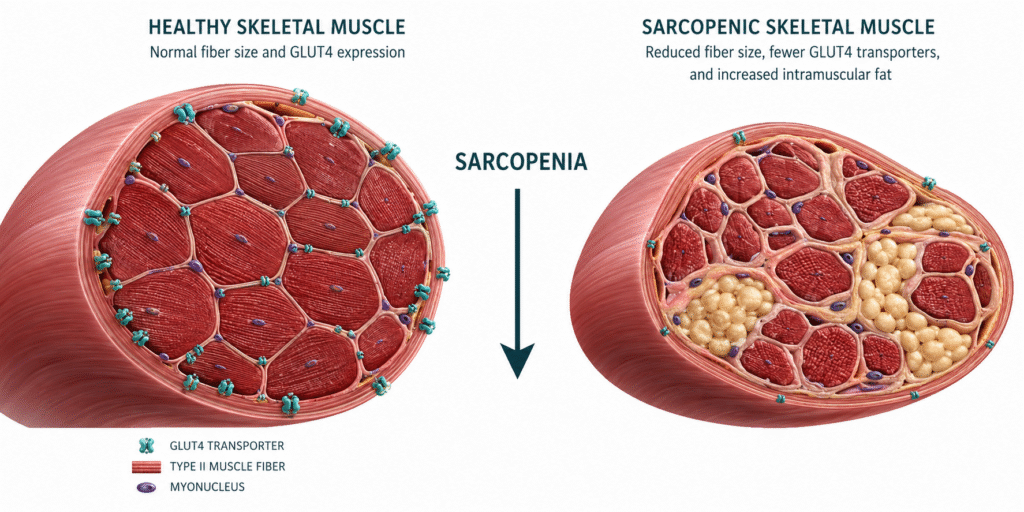
Sarcopenia reduces the body’s largest glucose disposal organ fiber by fiber — and the metabolic consequences begin long before any clinical threshold is crossed.
Most patients who come to me with insulin resistance, rising fasting glucose, increasing waist circumference, and declining energy have one thing in common that their previous practitioners never discussed: they are losing muscle. Not because they are sick in the conventional sense. Not because something dramatic has happened. Simply because muscle mass has been declining quietly for years — undetected, unmeasured, and entirely absent from their clinical conversation.
Sarcopenia is the progressive loss of skeletal muscle mass and function that begins in the fourth decade of life and accelerates without deliberate intervention. In standard clinical practice it is categorized, when it is categorized at all, as a geriatric syndrome — a fall-risk problem for older patients, addressed through physical therapy and perhaps a referral to an exercise physiologist. That framing misses the metabolic dimension entirely. Sarcopenia is not a consequence of aging that happens to affect metabolism on the side. It is a metabolic disease with systemic consequences that begin decades before any clinical threshold is crossed.
Understanding sarcopenia through a metabolic lens changes what clinicians look for, when they look for it, and what they do when they find it.
What you will learn: Why sarcopenia is a metabolic disease and not simply a geriatric syndrome | How muscle loss drives insulin resistance, fatty liver, and hormonal disruption through specific mechanisms | Why the conventional diagnostic threshold misses the majority of clinically relevant muscle loss | What the practical intervention looks like and why reframing is the first clinical task
What Sarcopenia Actually Is — and Why It Begins Earlier Than You Think
The term sarcopenia derives from the Greek for flesh and poverty. It was coined by Irwin Rosenberg in 1989 to describe the age-associated loss of skeletal muscle mass that he recognized as a major but underappreciated determinant of functional decline in older adults. The clinical definition has evolved since then to incorporate both mass and function — current consensus criteria from the European Working Group on Sarcopenia in Older People require evidence of low muscle strength as the primary criterion, with low muscle quantity or quality confirming the diagnosis and low physical performance indicating severity.
What those diagnostic thresholds do not capture is the earlier trajectory. Measurable muscle loss begins in the third to fourth decade in sedentary individuals — well before any clinical threshold is crossed and well before patients notice functional decline. After the age of 50, the rate of loss accelerates to approximately one to two percent of muscle mass per year in the absence of deliberate counter-pressure. Strength declines faster than mass — at roughly two to three percent per year after 60 — because the loss is not proportional across fiber types. Type II fast-twitch muscle fibers, which are the largest, most metabolically active fibers and the primary drivers of force production and glucose disposal, are lost preferentially and earlier.
This fiber-type specificity matters enormously for the metabolic picture. It is the type II fibers that contain the highest density of GLUT4 transporters, generate the greatest insulin-independent glucose disposal during contraction, and contribute most to post-exercise insulin sensitivity. Losing them preferentially while retaining a higher proportion of type I slow-twitch fibers means that the metabolic consequences of sarcopenia are disproportionate to the absolute change in muscle mass.
How Sarcopenia Drives Insulin Resistance
The metabolic consequences of sarcopenia flow from a single upstream fact: skeletal muscle is responsible for disposing of 75 to 85 percent of postprandial glucose under insulin-stimulated conditions. When muscle mass declines, that disposal capacity declines proportionally. Less muscle surface area means fewer GLUT4 translocation sites. Fewer translocation sites means slower glucose clearance after meals. Slower glucose clearance means the pancreas must produce more insulin to achieve the same result.
This is the mechanism by which sarcopenia generates and deepens insulin resistance — not through a single dramatic event but through the slow accumulation of reduced peripheral glucose disposal capacity over years or decades. The first laboratory signal is not elevated fasting glucose. It is elevated fasting insulin — the pancreas compensating for declining muscle function by working harder. As detailed in the post on insulin resistance, this compensatory hyperinsulinemia phase can persist silently for a decade or more before glucose begins to drift. By the time fasting glucose is flagged on a standard panel, the muscle loss driving the dysfunction has typically been accumulating for years.
The relationship is bidirectional, which is what makes it clinically dangerous. Insulin resistance impairs the anabolic signaling that would otherwise preserve muscle mass. Chronically elevated insulin downregulates growth hormone sensitivity and impairs IGF-1 signaling — two of the primary hormonal drivers of muscle protein synthesis. At the same time, the chronic low-grade inflammation that accompanies insulin resistance elevates circulating TNF-α and IL-6 from adipose tissue, both of which directly promote muscle protein catabolism. Muscle loss worsens insulin resistance. Insulin resistance accelerates muscle loss. The cycle is self-reinforcing and standard care almost never interrupts it because standard care almost never identifies it.
Sarcopenia, Fatty Liver, and the Hepatic Connection
The connection between sarcopenia and non-alcoholic fatty liver disease — now more accurately termed metabolic dysfunction-associated steatotic liver disease — is one of the most clinically significant and least discussed relationships in metabolic medicine.
The mechanism operates through reduced muscle glucose disposal. As muscle mass declines and peripheral glucose uptake slows, a greater proportion of dietary carbohydrate substrate is available for hepatic de novo lipogenesis — the liver’s conversion of excess glucose and fructose into triglycerides for storage. More substrate reaching the liver, in the context of already-elevated insulin driving lipogenic enzyme activity, means more liver fat accumulation. The connection between insulin resistance and this process is examined in detail in the post on insulin resistance and fatty liver.
Beyond substrate diversion, sarcopenia removes a second layer of hepatic protection: the myokine signals that contracting muscle normally delivers to the liver. Muscle-derived IL-6 and FGF-21 both modulate hepatic lipid metabolism and glucose output. As muscle mass and contraction frequency decline, those signals diminish. The liver loses a major source of metabolic regulation simultaneously as it receives an increased substrate load. The combination is a reliable pathway to hepatic fat accumulation — and it occurs at body weights that would not conventionally trigger a fatty liver workup. The role of myokines in this organ crosstalk is covered in the post on myokines.
Large epidemiological studies consistently confirm this relationship: low muscle mass is an independent predictor of NAFLD severity, and the association holds after controlling for BMI. Sarcopenic obesity — normal or elevated BMI with low muscle mass and high fat mass — carries a substantially worse metabolic prognosis than either condition alone, and it is invisible to weight-based clinical assessment.

Clinical Perspective: What I See in Practice
In my clinical experience in Germany, most patients have never heard the term sarcopenia, and even fewer recognize it as a metabolic condition. When it comes up at all in conventional medical settings, it is framed as a concern for the elderly — something to worry about at 75, not at 45 or 50. I start from scratch in virtually every conversation.
What I explain first is that muscle is not just tissue for movement. It is the body’s largest site for glucose disposal, a primary determinant of insulin sensitivity, and one of the strongest predictors of healthy aging across every major longitudinal study that has examined the question. As muscle mass and strength decline, metabolic flexibility declines with it — the capacity to shift efficiently between glucose and fat as fuel sources deteriorates, making it easier to accumulate visceral fat, harder to regulate appetite, and progressively more difficult to recover from metabolic stress.
The reframe that consistently shifts the conversation is this: you are not simply getting older. You are losing a metabolically active organ. And unlike most organ decline, this one responds directly to intervention.
Once patients understand that framing, the conversation changes. Instead of focusing exclusively on weight loss — which most patients have been told is the primary goal and which often fails because it addresses the downstream consequence rather than the upstream driver — we focus on preserving and rebuilding muscle through progressive resistance training and metabolism protocols, adequate protein intake, daily movement, restorative sleep, and correction of the underlying metabolic dysfunction that is accelerating the loss. That reframing transforms motivation in a way that caloric restriction messaging almost never does, because it gives patients a specific, buildable asset to work toward rather than a number to reduce.
What I see clinically is that patients who accept the muscle-first framing adhere to their protocols significantly better than those who remain focused on weight alone. They have a different relationship to the process — they are building something, not just losing something.
The Sarcopenic Obesity Trap
One of the most practically important concepts in this space is sarcopenic obesity — a phenotype characterized by low muscle mass coexisting with excess fat mass, typically with normal or near-normal BMI. It is more common than most clinicians expect, particularly in women in their forties and fifties who have dieted repeatedly, in men who were previously athletic and gradually deconditioned, and in patients who have lost weight rapidly without protein-adequate nutritional support.
The metabolic profile of sarcopenic obesity is worse than either sarcopenia or obesity alone. Low muscle mass means reduced glucose disposal capacity, reduced myokine output, and reduced resting metabolic rate. Excess fat mass — particularly visceral and ectopic fat — means elevated inflammatory cytokines, hepatic insulin resistance, and ongoing anabolic resistance in muscle tissue. The two conditions amplify each other’s metabolic consequences while simultaneously obscuring each other on standard assessment tools. BMI is normal. The patient does not look classically obese. Standard care has no particular flag to raise. Yet the metabolic machinery is severely compromised.
This is one of the clearest demonstrations of why body weight and BMI are inadequate clinical tools for metabolic assessment. The question that matters is not how much a patient weighs but what proportion of that weight is functional muscle versus stored fat, where that fat is distributed, and what the downstream metabolic markers reflect. Two patients at identical body weight can have dramatically different metabolic futures depending entirely on their muscle-to-fat composition.
What Drives Sarcopenia: Beyond Aging
While the age-related decline in anabolic hormones — testosterone, estrogen, growth hormone, IGF-1 — contributes to sarcopenia, framing it primarily as a hormonal inevitability of aging understates the degree to which modifiable factors drive the process.
Protein insufficiency is among the most prevalent and most correctable contributors. Many patients, particularly older women who have spent decades avoiding animal foods out of fear of saturated fat or cholesterol, are chronically under-consuming the leucine-rich animal protein that drives muscle protein synthesis. At the cellular level, muscle protein synthesis is a leucine-threshold phenomenon — there is a minimum leucine dose required to trigger the mTOR signaling cascade that initiates rebuilding. Plant-based protein sources generally deliver lower leucine concentrations per gram and with lower bioavailability, making it substantially harder to reach that threshold on plant-dominant diets without very careful attention to total intake.
Chronic sedentary behavior removes the mechanical stimulus that muscle tissue requires to maintain mass. Muscle does not maintain itself passively — it requires regular loading to justify its metabolic cost to the body. Without that signal, the body has no biological reason to preserve it. This is why even short periods of dramatically reduced movement — bed rest, illness, injury — produce rapid and measurable muscle loss, and why the trajectory of sarcopenia accelerates sharply in individuals who transition from active to sedentary lifestyles.
Sleep disruption elevates cortisol and growth hormone suppression, both of which directly impair muscle protein synthesis and accelerate catabolism. Chronic stress adds a further cortisol load. Vitamin D insufficiency — endemic across northern Europe and common in indoor-working populations globally — impairs muscle fiber function and is independently associated with sarcopenia risk. These are not peripheral factors. They are upstream drivers of the same metabolic dysfunction that makes insulin resistance so difficult to reverse without addressing the full system, as outlined in the post on muscle as an endocrine organ.
The Intervention: Rebuilding What Was Lost
The intervention for sarcopenia in a metabolic context is not complicated, but it requires commitment to multiple simultaneous levers — because sarcopenia is driven by multiple simultaneous factors.
Progressive resistance training is the primary stimulus. It generates the mechanical tension that drives local IGF-1 production, satellite cell activation, and GLUT4 upregulation. Two to three sessions per week targeting major compound movements at sufficient load to generate meaningful mechanical tension is the evidence-supported minimum. The specific interaction between resistance training and metabolic recovery is examined in detail in the post on resistance training and metabolism.
Protein intake at 1.6 grams per kilogram of ideal body weight, distributed across meals to ensure leucine threshold is met at each sitting, provides the substrate that training stimulus requires. For older patients with anabolic resistance — reduced muscle protein synthesis response per gram of protein consumed — the target rises toward 2.0 grams per kilogram. Animal-based, leucine-rich sources are prioritized: eggs, meat, fish, dairy.
Daily movement outside of formal training maintains contraction frequency, preserves GLUT4 activity between sessions, and sustains the myokine output that formal training initiates. The relationship between daily step count, Zone 2 walking, and cumulative metabolic benefit is covered in the post on Zone 2 training.
Sleep at seven to nine hours with attention to circadian alignment reduces the cortisol exposure that drives muscle catabolism overnight. Vitamin D optimization to 50 to 70 ng/mL supports muscle fiber function and insulin sensitivity simultaneously.

The Animal-Based Protocol for Insulin Resistance and Type 2 Diabetes
A Functional Medicine Framework
A Note on Uncertainty
The sarcopenia research base is substantial but contains important limitations. Diagnostic thresholds remain debated — the cutoffs used by different working groups do not perfectly align, and the optimal method for measuring muscle mass in clinical practice is not universally agreed upon. DXA scanning is the research standard but is not routinely available in primary care. Grip strength and gait speed serve as practical proxies but have their own limitations.
The precise contribution of sarcopenia to metabolic outcomes — versus the contribution of associated factors like sedentary behavior and poor nutrition — is difficult to isolate in observational research. What the evidence consistently supports is the directional relationship: preserving and rebuilding muscle mass through the interventions described above improves metabolic outcomes, reduces insulin resistance, and supports healthy aging across the available evidence base.
People Also Ask
What is sarcopenia?
Sarcopenia is the progressive loss of skeletal muscle mass and function associated with aging and chronic disuse. Current diagnostic criteria require evidence of low muscle strength, confirmed by low muscle quantity or quality. It begins measurably from the third to fourth decade in sedentary individuals, well before clinical thresholds are reached.
Is sarcopenia a metabolic disease?
Yes. Sarcopenia reduces the body’s primary glucose disposal organ, drives compensatory hyperinsulinemia, accelerates fatty liver progression, reduces myokine output, and worsens insulin resistance through a self-reinforcing cycle. Its metabolic consequences extend across the liver, pancreas, brain, and immune system.
What causes sarcopenia beyond aging?
The primary modifiable drivers are insufficient protein intake, chronic sedentary behavior, poor sleep, chronic stress, vitamin D insufficiency, and underlying insulin resistance. These factors interact and amplify each other, making sarcopenia substantially more preventable and reversible than its classification as an age-related syndrome implies.
Can sarcopenia be reversed?
Yes, partially. Progressive resistance training, adequate leucine-rich protein intake, daily movement, sleep optimization, and correction of underlying metabolic dysfunction can rebuild muscle mass and restore function at any age. The rate of recovery is slower in older patients and those with long-standing metabolic dysfunction, but meaningful reversal is consistently demonstrated in the literature.
What is sarcopenic obesity?
Sarcopenic obesity describes the coexistence of low muscle mass and excess fat mass, typically at normal or near-normal BMI. It carries a worse metabolic prognosis than either condition alone, is invisible to weight-based clinical assessment, and is more common than most clinicians recognize — particularly in patients who have dieted repeatedly without protein-adequate nutritional support.
How does sarcopenia cause fatty liver?
Sarcopenia reduces peripheral glucose disposal, increasing the carbohydrate substrate available for hepatic de novo lipogenesis. It simultaneously reduces the myokine signals — particularly muscle-derived IL-6 and FGF-21 — that regulate hepatic lipid metabolism. The combination reliably drives liver fat accumulation independently of body weight.
How much protein is needed to prevent sarcopenia?
A minimum of 1.6 grams per kilogram of ideal body weight is the evidence-supported threshold for maintaining muscle protein synthesis in active adults. Older patients and those with anabolic resistance may require up to 2.0 grams per kilogram. Protein should be distributed across meals to ensure leucine threshold is met at each sitting rather than concentrated in a single meal.
About the Author
Morteza Ariana is a State-Certified Functional Nutritionist based in Germany, specializing in insulin resistance, type 2 diabetes, and root-cause metabolic restoration. He holds advanced training in systems-based physiology and has worked with patients across the U.S. and Europe for over 10 years.
His clinical framework is built around a core principle that mainstream medicine consistently overlooks: chronically elevated insulin — not blood glucose — is the earliest and most actionable driver of metabolic disease. That conviction was shaped in part by his own experience with hyperinsulinemia in 2016, and deepened through a decade of clinical practice and the study of leading researchers in metabolic medicine including Benjamin Bikman, Joseph Kraft, Gerald Reaven, Jason Fung, and Stephen Phinney.
His work focuses on identifying and correcting the upstream metabolic signals — insulin load, liver-gut axis dysfunction, circadian misalignment, and micronutrient gaps — that standard screening misses entirely. Patient outcomes are documented, anonymized, and published on this site.
If this resonates, the next step is clarity
The Metabolic Restoration Blueprint is a structured 12-week framework designed to correct upstream metabolic drivers — not just manage symptoms.
Scientific References
Cruz-Jentoft AJ, Bahat G, Bauer J, et al. Sarcopenia: revised European consensus on definition and diagnosis. Age Ageing. 2019;48(1):16–31. 🔗 https://pubmed.ncbi.nlm.nih.gov/30312372/
Rosenberg IH. Sarcopenia: origins and clinical relevance. J Nutr. 1997;127(5 Suppl):990S–991S. 🔗 https://pubmed.ncbi.nlm.nih.gov/9164280/
Srikanthan P, Karlamangla AS. Relative muscle mass is inversely associated with insulin resistance and prediabetes. J Clin Endocrinol Metab. 2011;96(9):2898–2903. 🔗 https://pubmed.ncbi.nlm.nih.gov/21697234/
Petersen KF, Befroy D, Dufour S, et al. Mitochondrial dysfunction in the elderly: possible role in insulin resistance. Science. 2003;300(5622):1140–1142. 🔗 https://pubmed.ncbi.nlm.nih.gov/12750520/
Baumgartner RN, Wayne SJ, Waters DL, et al. Sarcopenic obesity predicts instrumental activities of daily living disability in the elderly. Obes Res. 2004;12(12):1995–2004. 🔗 https://pubmed.ncbi.nlm.nih.gov/15687401/
Atlantis E, Martin SA, Haren MT, et al. Inverse associations between muscle mass, strength, and the metabolic syndrome. Metabolism. 2009;58(7):1013–1022. 🔗 https://pubmed.ncbi.nlm.nih.gov/19394977/
Kim TN, Choi KM. Sarcopenia: definition, epidemiology, and pathophysiology. J Bone Metab. 2013;20(1):1–10. 🔗 https://pubmed.ncbi.nlm.nih.gov/24524049/
Morley JE, Anker SD, von Haehling S. Prevalence, incidence, and clinical impact of sarcopenia: facts, numbers, and epidemiology — update 2014. J Cachexia Sarcopenia Muscle. 2014;5(4):253–259. 🔗 https://pubmed.ncbi.nlm.nih.gov/25425503/
Volpi E, Mittendorfer B, Rasmussen BB, Wolfe RR. The response of muscle protein anabolism to combined hyperaminoacidemia and glucose-induced hyperinsulinemia is impaired in the elderly. J Clin Endocrinol Metab. 2000;85(12):4481–4490. 🔗 https://pubmed.ncbi.nlm.nih.gov/11134099/
Moore DR, Robinson MJ, Fry JL, et al. Ingested protein dose response of muscle and albumin protein synthesis after resistance exercise in young men. Am J Clin Nutr. 2009;89(1):161–168. 🔗 https://pubmed.ncbi.nlm.nih.gov/19056590/
Bhasin S, Apovian CM, Travison TG, et al. Effect of protein intake on lean body mass in functionally limited older men. JAMA Intern Med. 2018;178(4):530–541. 🔗 https://pubmed.ncbi.nlm.nih.gov/29459940/
Schaap LA, Pluijm SM, Deeg DJ, Visser M. Inflammatory markers and loss of muscle mass (sarcopenia) and strength. Am J Med. 2006;119(6):526.e9–17. 🔗 https://pubmed.ncbi.nlm.nih.gov/16750969/
Wannamethee SG, Shaper AG, Lennon L, Whincup PH. Decreased muscle mass and increased central adiposity are independently related to mortality in older men. Am J Clin Nutr. 2007;86(5):1339–1346. 🔗 https://pubmed.ncbi.nlm.nih.gov/17991645/
Holwerda AM, Paulussen KJM, Jetten J, et al. Physical activity performed in the evening increases the overnight muscle protein synthetic response to presleep protein ingestion in older men. J Nutr. 2016;146(7):1307–1314. 🔗 https://pubmed.ncbi.nlm.nih.gov/27281801/