
The hormonal imbalance your doctor is treating may not be a hormonal problem. Here is what the evidence actually shows.
Most patients with reproductive hormone disruption arrive having been told the same things. Your hormones are slightly off. It is probably stress. Try the pill. Come back if things get worse. What they are almost never told is this: the hormone levels on their panel are not the cause of what they are experiencing. They are the downstream consequence of a metabolic signal that has been operating for years — and that signal is insulin.
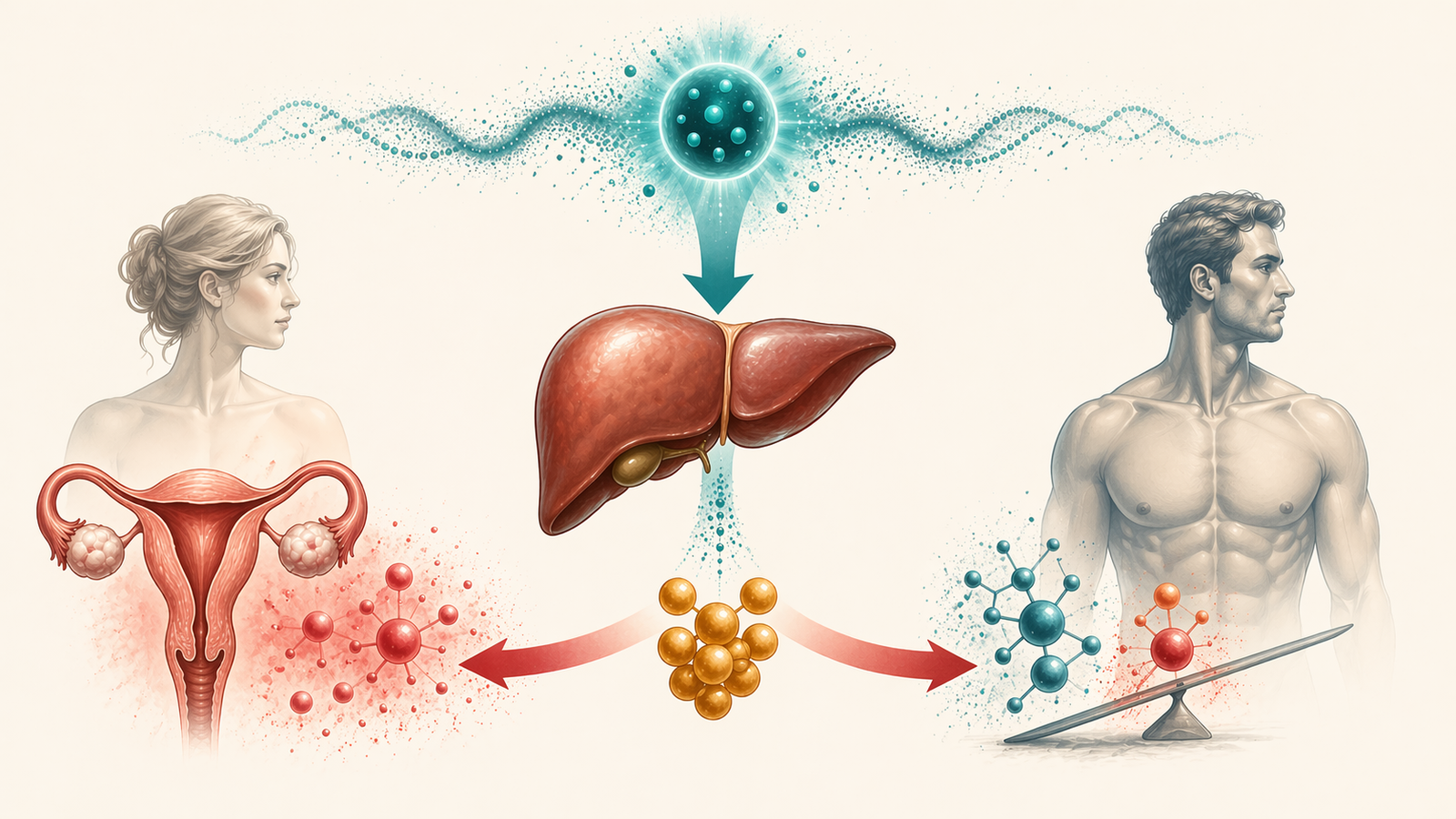
Insulin and reproductive hormones are connected through one of the most clinically important and most consistently overlooked mechanisms in metabolic medicine. Elevated insulin suppresses hepatic production of sex hormone-binding globulin. Low SHBG means more free, biologically active sex hormones circulating in the blood. More free androgens produce androgen symptoms in women. Altered testosterone and estrogen dynamics produce a slow decline in men. The hormonal picture is real. The driver behind it is metabolic. And because the driver is metabolic, it is directly and measurably addressable.
This post explains the mechanism in full — how insulin resistance disrupts reproductive hormone biology, why SHBG is the central mediator most clinicians never measure, and what actually changes when the metabolic environment is corrected.
What you will learn:
The direct mechanistic pathway from elevated insulin to altered sex hormone activity | Why SHBG is the most important reproductive hormone marker that almost no one is measuring | How insulin-driven hormone disruption expresses differently in women and men | The clinical case that almost every framework misses — and why regular cycles do not mean healthy hormonal physiology | What shifts first when insulin resistance is corrected, and in what sequence
The Diagnostic Journey: What These Patients Have Been Through
The history these patients bring follows a pattern that is, by now, familiar from every other post in this cluster. Years of symptoms that do not fit a clean diagnosis. Panels that come back normal. Reassurances that are not reassuring.
For women, the symptoms are typically visible and physical. Jawline acne that does not respond to topical treatment. Hair thinning or subtle unwanted growth. PMS that has gradually worsened. Fatigue and cravings that feel hormonal but do not have a hormonal explanation. Cycles that are regular — which means the PCOS checklist gets ticked as negative, the testosterone comes back within range, and the conversation ends.
For men, the presentation is quieter and slower. Gradual loss of drive and motivation. Central fat that accumulates despite reasonable diet and exercise. Libido that has quietly declined over years. Labs that show testosterone in the low-normal range — not low enough to diagnose, not high enough to reassure. The clinical picture is attributed to stress, aging, or lifestyle. The metabolic driver is not examined.
What both presentations share is this: by the time the patient arrives, fasting insulin has typically been elevated for years. SHBG has been suppressed for years. Free hormone activity has been dysregulated for years. The symptoms are the visible surface of a metabolic process that has been running underneath the entire time. And because the standard workup does not include fasting insulin or SHBG, the process remains invisible.
Clinical Perspective: What I See in Practice
When a patient arrives with reproductive hormone symptoms and normal standard labs, the first thing I look for is not the hormone level. It is the metabolic environment producing it.
The lab signature I see consistently is this: fasting insulin elevated — often between 10 and 18 µIU/mL, well above the functional optimal of below 5, but within the conventional reference range that flags nothing. SHBG suppressed — sometimes dramatically, sometimes subtly, but consistently low relative to what the free hormone picture requires. And free hormones altered as a direct consequence: free testosterone elevated in women, free testosterone dynamics shifted in men with estradiol rising relative to testosterone as visceral fat drives aromatization.
This is not a hormone production problem. It is a hormone binding problem. Insulin is suppressing the liver’s output of the protein that keeps sex hormones in their inactive, bound state. When SHBG falls, the same amount of total hormone produces a much larger active fraction. The patient has not suddenly started producing more testosterone. Their body has simply lost the capacity to keep it bound and inactive.
The most commonly missed patient in this picture is a woman between 28 and 38 who exercises, eats reasonably well, and has regular cycles. She arrives with jawline acne that topical treatments have not resolved, some hair thinning, worsening PMS, and energy crashes that feel hormonal. Her fasting glucose is normal. Her HbA1c is normal. Her TSH is normal. Her total testosterone is normal. She has been told her hormones are fine, or that it is stress, or that she has mild estrogen dominance. She may have been put on birth control to manage the symptoms.
What her panel has never included is fasting insulin, SHBG, and free testosterone. When those three markers are finally measured, the picture is clear: insulin elevated, SHBG suppressed, free testosterone high-normal or elevated. The mechanism is insulin-driven androgen excess. This is not classic PCOS — her cycles are regular, her ovaries may look entirely normal on ultrasound. But ovulation is occurring on top of a metabolically distorted hormonal environment. Regular cycles do not mean healthy hormonal physiology. They mean the reproductive system has not yet been disrupted enough to stop cycling. The biochemical shift is already present.
This case matters because it represents the early, reversible window — the point at which insulin is already driving hormone activity, but the structural reproductive consequences have not yet developed. Most clinical frameworks are binary: either you have PCOS or you are normal. This patient sits in the space between — pre-PCOS, insulin-driven androgen dysregulation, entirely addressable if identified correctly.
In men, the same upstream driver produces a different expression. Insulin suppresses SHBG in men as it does in women. But the downstream consequence unfolds more slowly and more quietly. Total testosterone may appear normal initially because free testosterone dynamics can compensate. Over time, visceral fat accumulates — driven by the same hyperinsulinemia — and the aromatase activity in that visceral fat converts testosterone to estradiol. The testosterone-to-estrogen ratio shifts. Energy, drive, recovery, and libido decline gradually. The patient is told it is aging. The fasting insulin driving the entire picture is never measured.
The distinction I make in every consultation is this: I am not looking at hormone levels in isolation. I am looking at the metabolic environment that is determining what those hormones can and cannot do. That shift in framing — from hormonal diagnosis to metabolic mechanism — is what changes the outcome.

The SHBG Mechanism: How Insulin and Reproductive Hormones Are Directly Connected
Sex hormone-binding globulin is produced by the liver. It binds testosterone, estradiol, and other sex steroids in the bloodstream, keeping them in an inactive, unavailable state. Only the unbound, free fraction of any sex hormone is biologically active and capable of binding to hormone receptors and producing physiological effects.
SHBG is exquisitely sensitive to insulin. When fasting insulin rises — even within the range that conventional labs consider normal — the liver reduces its SHBG output. This is a direct, well-characterized hepatic insulin effect. It does not require dramatically elevated insulin to be clinically significant. A fasting insulin of 12 µIU/mL produces meaningfully lower SHBG than a fasting insulin of 5 µIU/mL, even though both values fall within most conventional reference ranges.
The consequence of low SHBG is an increase in free, bioactive sex hormones — not because more hormones are being produced, but because less of what is being produced is being kept bound and inactive. This is the mechanism that produces androgen symptoms in women with entirely normal total testosterone. The total is normal. The free fraction is elevated. And the free fraction is what drives the biology.
In women, the elevated free androgen environment produced by low SHBG operates alongside a second insulin-mediated mechanism: direct stimulation of ovarian theca cell androgen production. Insulin acts on insulin receptors in ovarian theca cells and drives androgen synthesis — independently of LH signaling. This dual pathway — more androgen production plus less androgen binding — amplifies the free androgen excess that produces the clinical picture.
In men, the SHBG suppression from hyperinsulinemia alters the testosterone-to-estrogen ratio in a specific direction. Low SHBG means more free testosterone available for aromatization. Visceral fat, which accumulates as insulin resistance deepens, is rich in aromatase — the enzyme that converts testosterone to estradiol. More free testosterone plus more aromatase produces a rising estradiol-to-testosterone ratio. The result is the gradual testosterone decline and relative estrogen excess that characterizes insulin-driven male hormone disruption.
The liver is therefore the central organ in insulin’s effect on reproductive hormone biology. It produces SHBG in direct response to insulin signaling. When insulin is chronically elevated, the liver consistently underproduces SHBG — and the entire downstream hormonal environment reflects that deficit. Addressing the liver’s insulin load is not a tangential intervention in reproductive hormone dysfunction. It is the primary one.
Why Standard Hormone Testing Misses This Entirely
The standard reproductive hormone panel — total testosterone, total estradiol, LH, FSH, progesterone — measures hormone production and pituitary signaling. It does not measure hormone availability. It does not measure SHBG. It does not measure free hormone fractions. And it almost never includes fasting insulin.
This means the panel is looking at the wrong layer of the system. A woman with insulin-driven androgen excess and a suppressed SHBG can have a total testosterone that appears entirely normal. The pituitary signaling can look normal. The ovarian production can appear normal. What is not normal is the proportion of that normal total testosterone that is free and bioactive — and that proportion is determined by SHBG, which is determined by insulin, neither of which is on the standard panel.
The minimum panel that allows meaningful assessment of insulin’s effect on reproductive hormones includes fasting insulin, SHBG, and free testosterone or calculated free testosterone alongside the standard markers. In women, the timing of the panel relative to cycle phase matters — SHBG and free testosterone should ideally be measured in the early follicular phase for consistent comparison. In men, a morning fasting sample is required for accurate testosterone measurement.
Interpreting these markers in isolation misses the mechanism. Fasting insulin above 10 µIU/mL with SHBG below the functional optimal is the combination that identifies insulin as the driver — regardless of what total testosterone or total estradiol shows. This combination pattern is present in a large proportion of patients with reproductive hormone symptoms who have been told their labs are normal.
Insulin’s Effect on Reproductive Hormones: How It Differs Between Women and Men
The same upstream driver — chronic hyperinsulinemia — produces markedly different downstream expressions in women and men. Understanding these differences is what allows the clinical picture to be read correctly regardless of the patient’s sex.
In women, insulin-driven reproductive hormone disruption is louder, more visible, and appears earlier. Insulin acts directly on ovarian theca cells to drive androgen production, simultaneously suppresses SHBG to increase the free fraction of those androgens, and disrupts LH pulsatility to impair ovulation. The result is a spectrum of androgen excess — acne, hirsutism, hair changes — combined with ovulatory dysfunction that ranges from subtle luteal phase weakness to frank anovulation. The full PCOS picture is the advanced expression of this mechanism. But the mechanism is operating long before the diagnosis is made.
Women present earlier because even small shifts in free androgen levels produce visible, symptomatic consequences. Jawline acne, hair changes, and PMS worsen before any diagnostic threshold is crossed. The system is sensitive to these shifts in a way that makes early identification possible — if the right markers are measured.
In men, the expression is slower, quieter, and more easily attributed to other causes. Insulin suppresses SHBG, alters free testosterone dynamics, and — through visceral fat aromatization — progressively shifts the testosterone-to-estrogen ratio. The decline is gradual. Energy, drive, and recovery capacity reduce over months and years. The labs drift rather than shift. Men have a wider physiological buffer before symptoms become undeniable, which means the metabolic driver has typically been operating longer before anyone investigates it.
The practical clinical implication is that women are the earlier and more visible signal that insulin is disrupting reproductive hormone biology — but both sexes are affected by the same mechanism, and addressing insulin is the intervention in both cases.
What Changes When Insulin Resistance Is Corrected
When the metabolic environment driving reproductive hormone disruption is genuinely addressed, recovery follows a consistent and predictable sequence. The sequence is determined by the biology of SHBG — the marker that is most directly and most rapidly responsive to changes in insulin.
In the first one to two weeks, insulin begins to fall as dietary quality improves and the metabolic load reduces. Patients report more stable energy and fewer cravings. The metabolic environment is beginning to shift, but hormone markers have not yet moved.
Between weeks two and four, SHBG begins to rise measurably. This is the first objective laboratory signal of hormonal recovery. It precedes all other hormone changes because SHBG is a direct hepatic output of insulin signaling — the moment insulin falls, the liver begins producing more of it. This is the bridge between metabolic correction and hormonal normalization.
As SHBG rises, free testosterone falls in women — because more is now bound and inactive. Androgen symptoms begin to improve. Acne reduces. Hair changes slow. The shift in free hormone activity is real and clinically visible within weeks of meaningful metabolic improvement.
In the months that follow, the reproductive consequences of lower free hormone activity consolidate. Cycle regularity improves in women where it had been disrupted. Luteal phase progesterone output strengthens. In men, the testosterone-to-estrogen ratio begins to normalize as visceral fat reduces and aromatase activity decreases. Drive, motivation, and recovery capacity gradually improve.
The honest ceiling of this intervention is important to state clearly. SHBG responds quickly because it is a direct hepatic insulin output. Ovarian and testicular function respond more slowly because they are further downstream. In women whose cycles were already regular — like the clinical case described above — cycle regularity may not change much, because it was the free hormone environment rather than the cycle architecture that was disrupted. The improvement is in symptom resolution and biochemical normalization, not necessarily in cycle restructuring.
In women with established anovulatory PCOS, the timeline to ovulatory recovery varies with the depth of prior insulin resistance and the duration of the disruption. In men with significant visceral fat and established testosterone decline, meaningful recovery requires the combination of insulin correction and visceral fat reduction — the aromatase-driven conversion mechanism does not resolve until the adipose tissue driving it is reduced.
The Animal-Based Protocol for Insulin Resistance and Type 2 Diabetes
A Functional Medicine Framework
A Note on Uncertainty
The mechanistic relationship between insulin, SHBG, and free sex hormone activity is well-characterized and well-supported in the research literature. The direct suppression of hepatic SHBG production by insulin is among the most robust findings in this field. What is less precisely established in large randomized trial data is the proportion of patients with androgen symptoms or testosterone decline in whom metabolic correction alone produces complete hormonal normalization versus meaningful partial improvement. Individual response varies considerably depending on the duration of insulin resistance, the degree of prior hormonal disruption, and genetic factors affecting SHBG regulation.
The pre-PCOS early-window patient described in this post — regular cycles, normal total testosterone, insulin-driven androgen excess — is a clinically well-recognized pattern in functional medicine practice that has not yet been formally characterized in large epidemiological studies. The mechanistic basis for this presentation is sound. The clinical observation is consistent. The evidence base for describing it as a distinct diagnostic category is still developing.
All decisions regarding hormonal therapy, contraception, or fertility treatment must be made in collaboration with the treating physician. The metabolic approach described here addresses the upstream insulin signal driving reproductive hormone disruption — it does not replace gynaecological, endocrinological, or urological assessment where indicated.
Practical Implications
If you have reproductive hormone symptoms — androgen excess in women, testosterone decline in men — and your workup has consisted of total hormone levels and pituitary markers without measuring fasting insulin and SHBG, the mechanism driving your symptoms has not been assessed.
The practical starting point is requesting fasting insulin, SHBG, and free testosterone alongside your standard hormone panel. Calculate your HOMA-IR from fasting insulin and fasting glucose. Check your TG/HDL ratio — it is a reliable proxy for the insulin resistance driving the SHBG suppression.
If fasting insulin is above 10 µIU/mL and SHBG is low, insulin is the driver. That is where the intervention begins — not at the hormone level, but at the metabolic level. Correcting insulin resistance restores SHBG. Restored SHBG normalizes free hormone activity. Normalized free hormone activity resolves the symptoms that the hormone panels could not explain.
Your hormonal imbalance may not be a hormonal problem. It may be insulin — and insulin is directly addressable.
The insulin-reproductive hormone connection is one of the clearest demonstrations of why so many hormonal symptoms have metabolic root causes — a framework explored in full in the cluster cornerstone.
People Also Ask
How does insulin affect reproductive hormones?
Elevated insulin directly suppresses hepatic production of sex hormone-binding globulin. Low SHBG means a greater proportion of circulating sex hormones remain unbound and biologically active. In women, this produces elevated free testosterone and androgen symptoms. In men, it alters the testosterone-to-estrogen ratio through increased aromatization. The reproductive hormone disruption is a consequence of insulin dysregulation, not a primary hormonal condition.
What is SHBG and why does it matter for hormonal health?
Sex hormone-binding globulin is a liver-produced protein that binds testosterone and estradiol in the bloodstream, keeping them in an inactive state. Only free, unbound hormones are biologically active. When SHBG is suppressed by elevated insulin, more hormone is free and active — producing hormonal symptoms even when total hormone levels appear normal on standard testing. SHBG is the central mediator between insulin resistance and reproductive hormone disruption.
Can insulin resistance cause hormonal imbalance without PCOS?
Yes. Insulin can drive androgen excess and reproductive hormone disruption before the criteria for a formal PCOS diagnosis are met. A woman with regular cycles, normal total testosterone, elevated fasting insulin, and low SHBG is already experiencing insulin-driven androgen excess — even if she does not meet the Rotterdam diagnostic criteria for PCOS. This early-window presentation is one of the most commonly missed patterns in reproductive hormone medicine.
Why do women with normal cycles still have hormonal symptoms?
Regular cycles indicate that ovulation is occurring — but they do not indicate that the hormonal environment surrounding that cycle is healthy. Insulin can elevate free androgen activity, suppress SHBG, and drive androgen symptoms in women who are still ovulating regularly. The cycle architecture and the hormonal quality of that cycle are separate questions. Normal cycles plus insulin-driven androgen excess is a common and commonly missed combination.
How long does it take for hormones to improve after reducing insulin resistance?
SHBG is the first marker to respond — it begins rising measurably within two to four weeks of meaningful insulin reduction, because it is a direct hepatic output of insulin signaling. Free testosterone falls as SHBG rises, and androgen symptoms begin improving within weeks. Cycle regularity, luteal phase progesterone, and testosterone-to-estrogen dynamics in men follow over months. The sequence is consistent: insulin falls first, SHBG rises next, free hormone activity normalizes, reproductive function follows.
What tests should I request if I think insulin is affecting my hormones?
Request fasting insulin, SHBG, and free testosterone alongside your standard hormone panel. Calculate HOMA-IR from fasting insulin and fasting glucose. Check triglycerides and HDL to calculate the TG/HDL ratio — a reliable proxy for insulin resistance. These markers reveal the metabolic mechanism driving reproductive hormone disruption that standard hormone panels are not designed to detect.
About the Author
Morteza Ariana is a State-Certified Functional Nutritionist based in Germany, specializing in insulin resistance, type 2 diabetes, and root-cause metabolic restoration. He holds advanced training in systems-based physiology and has worked with patients across the U.S. and Europe for over 10 years.
His clinical framework is built around a core principle that mainstream medicine consistently overlooks: chronically elevated insulin — not blood glucose — is the earliest and most actionable driver of metabolic disease. That conviction was shaped in part by his own experience with hyperinsulinemia in 2016, and deepened through a decade of clinical practice and the study of leading researchers in metabolic medicine including Benjamin Bikman, Joseph Kraft, Gerald Reaven, Jason Fung, and Stephen Phinney.
His work focuses on identifying and correcting the upstream metabolic signals — insulin load, liver-gut axis dysfunction, circadian misalignment, and micronutrient gaps — that standard screening misses entirely. Patient outcomes are documented, anonymized, and published on this site.
If this resonates, the next step is clarity
The Metabolic Restoration Blueprint is a structured 12-week framework designed to correct upstream metabolic drivers — not just manage symptoms.
Key References
1. Selva DM, Hogeveen KN, Innis SM, Hammond GL. Monosaccharide-induced lipogenesis regulates the human hepatic sex hormone-binding globulin gene. Journal of Clinical Investigation. 2007;117(12):3979–3987. 🔗 https://pubmed.ncbi.nlm.nih.gov/18060036/
2. Nestler JE, Powers LP, Matt DW, et al. A direct effect of hyperinsulinemia on serum sex hormone-binding globulin levels in obese women with the polycystic ovary syndrome. Journal of Clinical Endocrinology & Metabolism. 1991;72(1):83–89. 🔗 https://pubmed.ncbi.nlm.nih.gov/1986032/
3. Dunaif A. Insulin resistance and the polycystic ovary syndrome: mechanism and implications for pathogenesis. Endocrine Reviews. 1997;18(6):774–800. 🔗 https://pubmed.ncbi.nlm.nih.gov/9408743/
4. Pitteloud N, Mootha VK, Dwyer AA, et al. Relationship between testosterone levels, insulin sensitivity, and mitochondrial function in men. Diabetes Care. 2005;28(7):1636–1642. 🔗 https://pubmed.ncbi.nlm.nih.gov/15983313/
5. Vermeulen A, Kaufman JM, Deslypere JP, Thomas G. Attenuated luteinizing hormone (LH) pulse amplitude but normal LH pulse frequency, and its relation to plasma androgens in hypogonadism of obese men. Journal of Clinical Endocrinology & Metabolism. 1993;76(5):1140–1146. 🔗 https://pubmed.ncbi.nlm.nih.gov/8496304/
6. Grossmann M. Low testosterone in men with type 2 diabetes: significance and treatment. Journal of Clinical Endocrinology & Metabolism. 2011;96(8):2341–2353. 🔗 https://pubmed.ncbi.nlm.nih.gov/21646372/
7. Reaven GM. Role of insulin resistance in human disease. Diabetes. 1988;37(12):1595–1607. 🔗 https://pubmed.ncbi.nlm.nih.gov/3056758/
8. Azziz R, Carmina E, Chen Z, et al. Polycystic ovary syndrome. Nature Reviews Disease Primers. 2016;2:16057. 🔗 https://pubmed.ncbi.nlm.nih.gov/27510637/
9. Stellato RK, Feldman HA, Hamdy O, Horton ES, McKinlay JB. Testosterone, sex hormone-binding globulin, and the development of type 2 diabetes in middle-aged men. Diabetes Care. 2000;23(4):490–494. 🔗 https://pubmed.ncbi.nlm.nih.gov/10857940/
10. Plymate SR, Matej LA, Jones RE, Friedl KE. Inhibition of sex hormone-binding globulin production in the human hepatoma (Hep G2) cell line by insulin and prolactin. Journal of Clinical Endocrinology & Metabolism. 1988;67(3):460–464. 🔗 https://pubmed.ncbi.nlm.nih.gov/3403065/
11. Tosi F, Negri C, Perrone F, et al. Hyperinsulinemia amplifies LH-stimulated androgen biosynthesis in women with polycystic ovary syndrome. Journal of Clinical Endocrinology & Metabolism. 2012;97(5):1712–1719. 🔗 https://pubmed.ncbi.nlm.nih.gov/22362819/
12. Zitzmann M. Testosterone deficiency, insulin resistance and the metabolic syndrome. Nature Reviews Endocrinology. 2009;5(12):673–681. 🔗 https://pubmed.ncbi.nlm.nih.gov/19859071/