
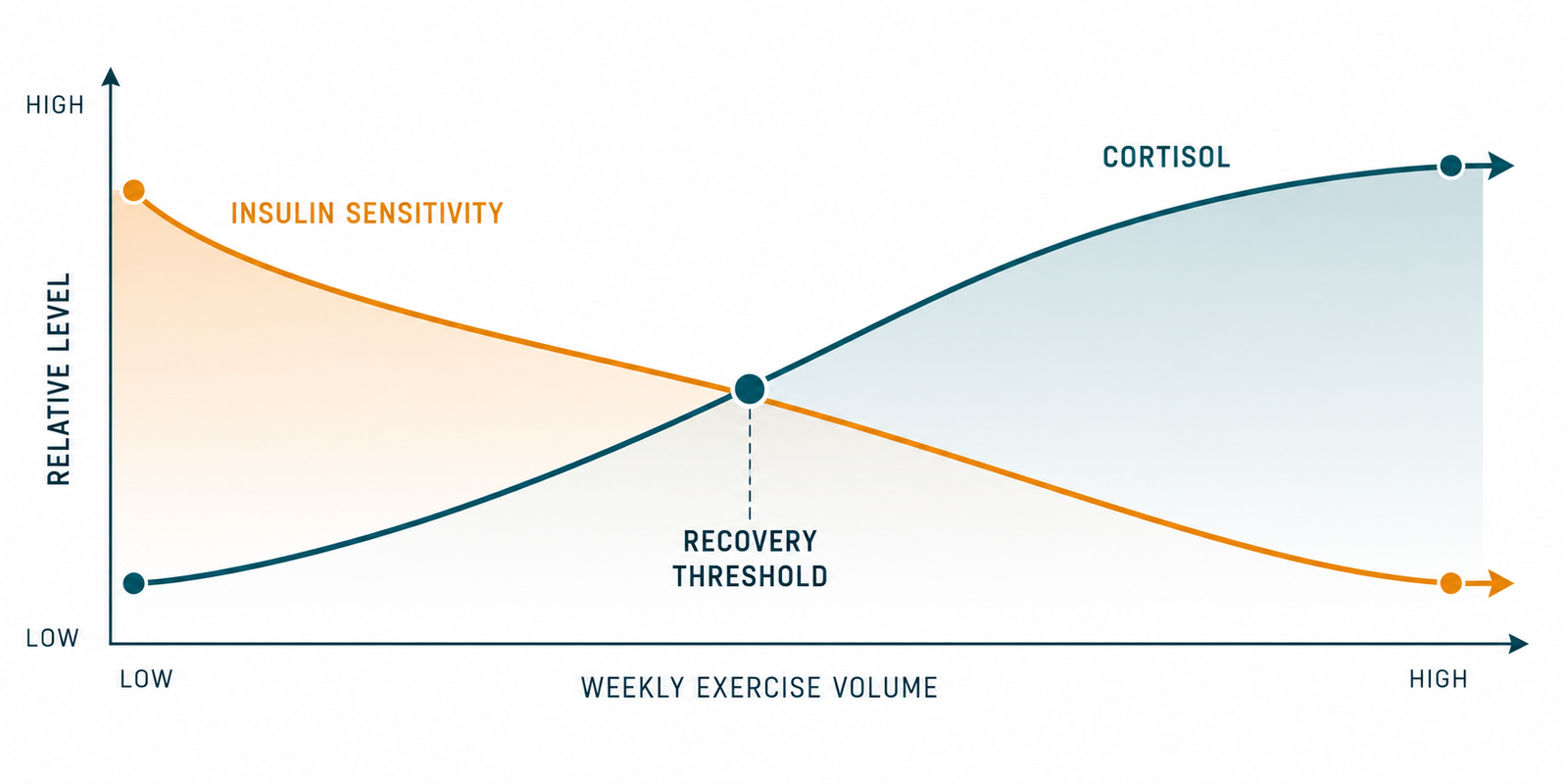
Chronic cardio stress occurs when training volume consistently exceeds recovery capacity — cortisol rises, insulin sensitivity falls, and more exercise produces diminishing metabolic returns.
There is a deeply embedded assumption in modern health culture that more exercise is always better. If you are overweight, exercise more. If your metabolic markers are not improving, add another session. If fat is not moving, increase the cardio. This assumption is so widely held that patients who follow it faithfully — running five days a week, attending daily spinning classes, logging hours on the bike — are genuinely bewildered when their metabolism does not respond the way the logic suggests it should.
The clinical reality is more nuanced. Exercise is not a calorie-burning transaction. It is a biological signal. And like any biological signal, its effect depends entirely on whether the receiving system has the capacity to respond, adapt, and recover. When it does not — when the cumulative stress load from training, work, poor sleep, caloric restriction, and metabolic dysfunction exceeds recovery capacity — chronic cardio does not improve metabolic health. It adds to the dysfunction driving it.
This post examines the physiology behind chronic cardio stress, the clinical pattern it produces, and why reducing exercise volume while optimizing exercise type and recovery frequently produces better metabolic outcomes than adding more training ever did.
What you will learn: Why exercise is a stressor and why that matters metabolically | The cortisol, insulin, and sleep pattern that characterizes chronic cardio stress | Why high exercise volume does not compensate for insulin resistance | How to reframe exercise dose for a metabolically compromised patient | What the evidence actually says about cardio and cardiometabolic health
Exercise Is a Stressor — and Stress Has a Dose
Every bout of exercise is a physiological stressor. Muscle fibers are damaged, energy stores are depleted, cortisol rises, and the immune system mounts a transient inflammatory response. This is not a problem — it is the mechanism. The body adapts to that stress by rebuilding stronger, more efficient tissue, and the net result is improved fitness, insulin sensitivity, and metabolic function. The entire benefit of exercise depends on this stress-adaptation cycle operating correctly.
The cycle has two phases: the training stimulus and the recovery. Both are required. A training stimulus without adequate recovery does not produce adaptation — it produces accumulated damage. The body does not become healthier during the workout. It becomes healthier while recovering from it.
This distinction is clinically significant because the recovery phase is not passive. It requires sleep, adequate protein, hormonal balance, and a total stress load that leaves sufficient physiological resources for repair. When those conditions are not met — when a patient is sleeping poorly, eating in a caloric deficit, carrying chronic occupational stress, and training intensely five or six days a week — the recovery phase is perpetually compromised. The training stimulus accumulates. The adaptation does not.
The question that determines whether a given exercise protocol is beneficial or counterproductive is not how much exercise the body can tolerate. It is what kind of exercise the body can adapt to and recover from.
The Cortisol Problem
Cortisol is the primary stress hormone, produced by the adrenal cortex in response to physical and psychological stressors. In the context of exercise, cortisol serves important acute functions: it mobilizes glucose and fatty acids for fuel, suppresses non-essential immune activity, and maintains performance during the training session. Acutely elevated cortisol from a single exercise bout is normal and appropriate.
The problem arises when cortisol remains chronically elevated — or when the HPA axis dysregulates and cortisol no longer follows its normal diurnal pattern. In patients combining intense daily training with inadequate sleep, caloric restriction, and high occupational stress, the cumulative cortisol load can remain persistently elevated. The result is a hormonal environment that directly opposes metabolic recovery.
Chronically elevated cortisol promotes gluconeogenesis — the liver’s production of new glucose from non-carbohydrate substrates — which raises fasting glucose and increases the insulin demand on the pancreas. It promotes muscle protein catabolism, degrading the very tissue that resistance training and zone 2 training are attempting to build and maintain. It drives visceral fat accumulation through cortisol receptors that are particularly dense in intra-abdominal adipose tissue. And it directly impairs insulin signaling in peripheral tissues, deepening the insulin resistance that the exercise was supposed to address.
The clinical picture that emerges is distinctive and recognizable: patients who are exhausted but cannot sleep, who train hard but accumulate central fat, who feel “wired but tired” — alert late at night, unrefreshed in the morning, and depleted by mid-afternoon. This is not a motivation problem. It is a hormonal one. The cortisol pattern has inverted, and the metabolic consequences follow directly.
It is important to note that cortisol assessment is not straightforward. A single measurement — fasting morning cortisol, for instance — rarely captures the full picture. Diurnal rhythm matters more than any single value, and clinical context must inform interpretation. Patients who present with the symptom pattern described above warrant a more thorough assessment than a single cortisol draw.
Fasting Insulin Remains Elevated Despite High Exercise Volume
One of the most striking findings in patients with chronic cardio stress is that fasting insulin frequently remains elevated despite the volume of exercise they are performing. This surprises patients who have been told that exercise improves insulin sensitivity — which it does, under the right conditions. But the right conditions are not present when recovery is compromised.
The mechanisms are multiple. Chronically elevated cortisol directly impairs insulin signaling through serine phosphorylation of IRS-1 — the same molecular mechanism by which inflammatory cytokines impair insulin action. Persistent sleep disruption reduces insulin sensitivity independently of exercise, through effects on growth hormone secretion, cortisol rhythm, and appetite-regulating hormones. Caloric restriction without adequate protein intake reduces muscle mass over time, shrinking the glucose disposal capacity that insulin sensitivity depends on, as detailed in the post on skeletal muscle and metabolic health.
The dietary pattern that frequently accompanies high cardio volume compounds the problem. Many high-volume cardio patients eat frequently — multiple small meals and snacks throughout the day — to fuel their training. This pattern keeps insulin elevated throughout the day, suppressing fat oxidation and preventing the insulin-low periods that allow metabolic flexibility to develop. As covered in the post on metabolic flexibility, the ability to shift between glucose and fat as fuel sources requires periods of low insulin — periods that constant fueling around training eliminates.
The result is a patient who is highly active, consuming significant calories, producing significant cortisol, and still hyperinsulinemic. Exercise volume is not the limiting variable. Recovery, insulin load, and sleep are.

Clinical Perspective: What I See in Practice
The patients I encounter with chronic cardio stress share a consistent profile. They are exercising five or six days a week — running, cycling, HIIT classes, spinning — and cannot understand why they are not seeing results proportional to their effort. They are often tired throughout the day despite sleeping seven or eight hours, they have difficulty losing abdominal fat despite the caloric expenditure of their training, and they frequently experience energy crashes that they manage with caffeine and additional carbohydrate.
When we look at their markers, fasting insulin is elevated despite the exercise volume. The TG/HDL ratio — one of the most reliable practical proxies for insulin resistance as covered in the post on the TG/HDL ratio — is often above 2.5. Sleep complaints are consistent: difficulty falling asleep despite physical exhaustion, waking in the early hours, and feeling unrefreshed regardless of time in bed. Waist circumference is not decreasing despite the training volume.
I do not tell these patients that exercise is the problem. What I tell them is that their body is not currently responding well to the type of stress they are applying. The framing I use is direct: “Your body does not need more exercise right now. It needs more efficient exercise and better recovery. You become healthier while recovering from training — not during it.”
That reframe changes the conversation entirely. Instead of defending their exercise identity — which is real and worth preserving — patients begin to understand that the goal is not maximum training volume but optimal training stimulus matched to recovery capacity. That is a clinically different question, and it opens the door to a protocol restructure they are willing to implement.
The restructure that consistently produces better outcomes than adding more cardio: replacing several high-intensity sessions with daily Zone 2 walking, adding resistance training and metabolism protocols two to three times per week, prioritizing sleep as a first-order metabolic intervention, increasing protein intake to support muscle preservation, and introducing appropriate meal spacing to allow insulin to return to baseline between eating occasions. This combination typically produces measurable improvements in fasting insulin, energy, body composition, and sleep quality within eight to twelve weeks — often faster than years of high-volume cardio ever did.
Why High-Intensity Cardio Is a Specific Problem in Metabolically Compromised Patients
The cardio-stress problem is not universal. In metabolically healthy, well-recovered athletes with adequate sleep, protein intake, and low baseline stress, high-volume endurance training is not harmful — it is what produces elite performance. The issue is specific to patients who are metabolically compromised: those with insulin resistance, poor sleep, significant occupational stress, inadequate protein intake, and insufficient recovery between sessions.
In these patients, high-intensity cardio generates a cortisol load that their HPA axis cannot resolve between sessions. It depletes muscle glycogen repeatedly without the anabolic conditions — adequate protein, growth hormone, testosterone — required to fully restore it. It generates reactive oxygen species at a rate that exceeds antioxidant capacity in mitochondria that are already dysfunctional from insulin resistance. And it activates the sympathetic nervous system repeatedly without the parasympathetic recovery periods that allow cardiovascular and hormonal systems to return to baseline.
The mismatch between training stimulus and recovery capacity is the core problem. High-intensity cardio in a metabolically compromised patient is not the same biological event as high-intensity cardio in a metabolically healthy one. The same external stimulus produces a different internal response depending on the physiological state receiving it.
This has direct implications for how chronic cardio stress interacts with sarcopenia. High-volume endurance training without adequate protein and resistance stimulus accelerates the preferential loss of type II muscle fibers that sarcopenia is characterized by. Patients who have been running heavily for years without resistance training frequently present with low muscle mass despite their apparent fitness level — what the research literature describes as the “skinny fat” or sarcopenic lean phenotype. Their cardiovascular capacity may be intact. Their metabolic muscle — the tissue responsible for glucose disposal and myokine signaling — is significantly depleted.
The Myokine Dimension
An often-overlooked consequence of chronic cardio stress is its effect on myokine signaling. As covered in detail in the posts on muscle as an endocrine organ and myokines, contracting muscle produces a broad family of signaling proteins that regulate inflammation, insulin sensitivity, and organ function across the body. These signals are beneficial when produced in the context of adequate recovery. When training volume exceeds recovery capacity, the chronic inflammatory state that results begins to interfere with myokine signaling — reducing the anti-inflammatory effects of muscle-derived IL-6 and blunting the irisin response that supports fat browning and insulin sensitivity.
The net effect is that a patient doing excessive high-intensity cardio without adequate recovery may be producing fewer beneficial myokine signals per session than a patient doing moderate Zone 2 walking consistently — because the inflammatory background noise from overtraining drowns out the specific metabolic signals that contraction is attempting to generate.
What the Evidence Actually Says
It is important to be precise about what the evidence supports. The research base for aerobic exercise in cardiometabolic health is robust and consistent: regular moderate-intensity aerobic exercise reduces cardiovascular risk, improves insulin sensitivity, lowers triglycerides, and reduces all-cause mortality. This evidence is not in dispute, and nothing in this post argues against aerobic exercise.
What the evidence also shows — in a smaller but growing body of research on overtraining syndrome, HPA axis dysregulation, and exercise-induced cortisol excess — is that more is not linearly better, particularly in populations with pre-existing metabolic dysfunction, poor sleep, and high baseline stress. The relationship between exercise dose and metabolic benefit is an inverted U: too little produces inadequate stimulus, the optimal range produces adaptation, and too much in the wrong context produces counter-regulatory stress responses that impair the adaptations exercise is intended to generate.
The practical implication is not to reduce exercise. It is to optimize the type, intensity, and recovery context of exercise for the individual’s current physiological state. For most metabolically compromised patients, that means less high-intensity cardio, more Zone 2 walking, structured resistance training, and a serious clinical focus on sleep and recovery as metabolic interventions in their own right.

The Animal-Based Protocol for Insulin Resistance and Type 2 Diabetes
A Functional Medicine Framework
A Note on Uncertainty
The overtraining and chronic cardio stress literature, while clinically informative, is less precisely characterized than the resistance training or Zone 2 research base. Much of the mechanistic evidence comes from studies of competitive endurance athletes rather than sedentary or metabolically compromised patients beginning exercise programs.
Individual variation in cortisol response, HPA axis resilience, and recovery capacity is substantial. What constitutes “too much” cardio for any given patient depends on their sleep quality, dietary adequacy, stress load, hormonal status, and baseline metabolic health — variables that interact in ways that make precise universal thresholds impossible to define. The directional evidence is consistent: in metabolically compromised patients with poor recovery, high-intensity cardio volume should be modulated in favor of Zone 2 and resistance training before being increased.
People Also Ask
Can too much cardio cause insulin resistance?
Chronically excessive high-intensity cardio can worsen insulin resistance in metabolically compromised patients by elevating cortisol, impairing sleep, promoting muscle catabolism, and generating a pro-inflammatory state that directly impairs insulin signaling. This is distinct from the well-documented benefit of moderate aerobic exercise on insulin sensitivity in healthy, well-recovered individuals.
Why am I not losing weight despite exercising every day?
High daily exercise volume without adequate recovery elevates cortisol, which promotes visceral fat accumulation and impairs fat oxidation. Frequent eating around training keeps insulin elevated, suppressing fat mobilization. Poor sleep from overtraining reduces growth hormone and increases appetite-stimulating hormones. The combination produces a metabolic environment that resists fat loss despite the caloric expenditure of training.
What is chronic cardio stress?
Chronic cardio stress describes the physiological state produced when high-volume endurance exercise consistently exceeds recovery capacity. It is characterized by persistently elevated cortisol, HPA axis dysregulation, impaired sleep, elevated fasting insulin despite exercise, declining performance, and difficulty losing abdominal fat. It is not a fixed diagnosis but a clinical pattern recognized in functional and sports medicine.
Is cardio bad for insulin resistance?
Moderate aerobic exercise — particularly Zone 2 training — is beneficial for insulin resistance through mitochondrial biogenesis and improved fat oxidation. The problem is not cardio per se but high-intensity, high-volume cardio in patients whose recovery capacity is already compromised by poor sleep, chronic stress, and metabolic dysfunction. The dose and type of cardio determine whether the effect is beneficial or counterproductive.
Why do I feel worse after exercise?
Feeling worse after exercise — increased fatigue, poor sleep, declining mood, persistent soreness — typically indicates that the training stimulus is exceeding recovery capacity. In metabolically compromised patients, this often reflects elevated baseline cortisol, inadequate protein intake, poor sleep quality, or a training volume that the current physiological state cannot absorb and adapt to.
What should I do instead of high-intensity cardio for metabolic health?
The combination that consistently produces superior metabolic outcomes in insulin-resistant patients is Zone 2 walking four to five days per week, resistance training two to three times per week, protein intake at 1.6 grams per kilogram of ideal body weight, adequate sleep, and appropriate meal spacing. This protocol addresses the upstream drivers of insulin resistance more directly than high-volume cardio without the counterproductive cortisol load.
How long does it take to recover from chronic cardio stress?
Recovery from chronic cardio stress — normalization of cortisol rhythm, restoration of sleep quality, improvement in fasting insulin, and return of energy — typically requires eight to twelve weeks of reduced training volume, improved sleep, adequate protein intake, and stress management. Individual variation is substantial depending on the severity and duration of the overtraining state.
About the Author
Morteza Ariana is a State-Certified Functional Nutritionist based in Germany, specializing in insulin resistance, type 2 diabetes, and root-cause metabolic restoration. He holds advanced training in systems-based physiology and has worked with patients across the U.S. and Europe for over 10 years.
His clinical framework is built around a core principle that mainstream medicine consistently overlooks: chronically elevated insulin — not blood glucose — is the earliest and most actionable driver of metabolic disease. That conviction was shaped in part by his own experience with hyperinsulinemia in 2016, and deepened through a decade of clinical practice and the study of leading researchers in metabolic medicine including Benjamin Bikman, Joseph Kraft, Gerald Reaven, Jason Fung, and Stephen Phinney.
His work focuses on identifying and correcting the upstream metabolic signals — insulin load, liver-gut axis dysfunction, circadian misalignment, and micronutrient gaps — that standard screening misses entirely. Patient outcomes are documented, anonymized, and published on this site.
If this resonates, the next step is clarity
The Metabolic Restoration Blueprint is a structured 12-week framework designed to correct upstream metabolic drivers — not just manage symptoms.
Scientific References
Smith LL. Cytokine hypothesis of overtraining: a physiological adaptation to excessive stress? Med Sci Sports Exerc. 2000;32(2):317–331. 🔗 https://pubmed.ncbi.nlm.nih.gov/10694114/
Kreher JB, Schwartz JB. Overtraining syndrome: a practical guide. Sports Health. 2012;4(2):128–138. 🔗 https://pubmed.ncbi.nlm.nih.gov/23016079/
Meeusen R, Duclos M, Foster C, et al. Prevention, diagnosis, and treatment of the overtraining syndrome. Med Sci Sports Exerc. 2013;45(1):186–205. 🔗 https://pubmed.ncbi.nlm.nih.gov/23247672/
Cadegiani FA, Kater CE. Hypothalamic-pituitary-adrenal (HPA) axis functioning in overtraining syndrome. Endocr Connect. 2017;6(8):R167–R181. 🔗 https://pubmed.ncbi.nlm.nih.gov/29038160/
Hackney AC. Stress and the neuroendocrine system: the role of exercise as a stressor and modifier of stress. Expert Rev Endocrinol Metab. 2006;1(6):783–792. 🔗 https://pubmed.ncbi.nlm.nih.gov/30754144/
Epel ES, McEwen B, Seeman T, et al. Stress and body shape: stress-induced cortisol secretion is consistently greater among women with central fat. Psychosom Med. 2000;62(5):623–632. 🔗 https://pubmed.ncbi.nlm.nih.gov/11020090/
Dallman MF, Pecoraro N, Akana SF, et al. Chronic stress and obesity: a new view of “comfort food.” Proc Natl Acad Sci USA. 2003;100(20):11696–11701. 🔗 https://pubmed.ncbi.nlm.nih.gov/12975524/
Spiegel K, Tasali E, Penev P, Van Cauter E. Brief communication: sleep curtailment in healthy young men is associated with decreased leptin levels, elevated ghrelin levels, and increased hunger and appetite. Ann Intern Med. 2004;141(11):846–850. 🔗 https://pubmed.ncbi.nlm.nih.gov/15583226/
Leproult R, Van Cauter E. Role of sleep and sleep loss in hormonal release and metabolism. Endocr Dev. 2010;17:11–21. 🔗 https://pubmed.ncbi.nlm.nih.gov/19955752/
Pedersen BK, Febbraio MA. Muscles, exercise and obesity: skeletal muscle as a secretory organ. Nat Rev Endocrinol. 2012;8(8):457–465. 🔗 https://pubmed.ncbi.nlm.nih.gov/22473333/
Hawley JA, Lessard SJ. Exercise training-induced improvements in insulin action. Acta Physiol. 2008;192(1):127–135. 🔗 https://pubmed.ncbi.nlm.nih.gov/18171429/
Tremblay MS, Colley RC, Saunders TJ, et al. Physiological and health implications of a sedentary lifestyle. Appl Physiol Nutr Metab. 2010;35(6):725–740. 🔗 https://pubmed.ncbi.nlm.nih.gov/21164543/
Venables MC, Jeukendrup AE. Physical inactivity and obesity: links with insulin resistance and type 2 diabetes mellitus. Diabetes Metab Res Rev. 2009;25(Suppl 1):S18–S23. 🔗 https://pubmed.ncbi.nlm.nih.gov/19662617/
Selye H. Stress and the general adaptation syndrome. Br Med J. 1950;1(4667):1383–1392. 🔗 https://pubmed.ncbi.nlm.nih.gov/15426939/