
Elevated liver enzymes are one of the most common findings in a standard blood panel — and one of the most consistently misread. Not misread as in incorrectly flagged. Misread as in correctly reported and then completely misinterpreted in terms of what they actually mean and what they are actually indicating about your metabolic health.
ALT at 41 U/L is reported as normal. GGT at 28 U/L is reported as normal. AST at 26 U/L is reported as normal. The patient is told there is nothing to worry about. Annual monitoring is recommended. The appointment ends.
What those numbers are actually indicating — when read through a functional medicine lens, against functional thresholds, in the context of the full metabolic picture — is a liver under early metabolic strain, a gut-liver axis under stress, and an insulin resistance trajectory that has been silently developing for months or years. The numbers are not normal. They are early. And early is exactly when intervention produces the most complete and durable results.
This post explains what ALT, AST, and GGT actually measure, why the conventional reference ranges consistently fail to identify early metabolic dysfunction, what the functional medicine thresholds are and why they differ so substantially from standard lab ranges, and what the combination patterns in these three markers reveal about the upstream biological drivers that standard screening is not designed to find.
What you will learn:
Why ALT and AST are damage markers and GGT is something fundamentally different and more important for early detection | The functional medicine thresholds for all three enzymes and why they diverge sharply from conventional reference ranges | What specific combination patterns reveal about insulin resistance, gut-liver axis disruption, and hepatic metabolic stress | Why GGT is consistently the earliest signal in the metabolic dysfunction trajectory | What to do when your enzymes are elevated — and what to do when they are not, but everything else points toward a problem
Clinical Perspective: What I See in Practice
In over a decade of clinical practice, I have not encountered a single patient who arrived having been told by their GP that a mildly elevated GGT was an early warning signal for insulin resistance. Not one. GGT at 28 U/L, ALT at 38 U/L — these numbers sit within the conventional reference range and receive no clinical attention whatsoever.
The conversation, when it happens at all, is brief and dismissive: your liver markers are slightly elevated, we will monitor them. What is driving the elevation, what organ systems are involved, and what the number is actually indicating about the metabolic state upstream — none of that is communicated. Patients leave not knowing they have a signal worth acting on.
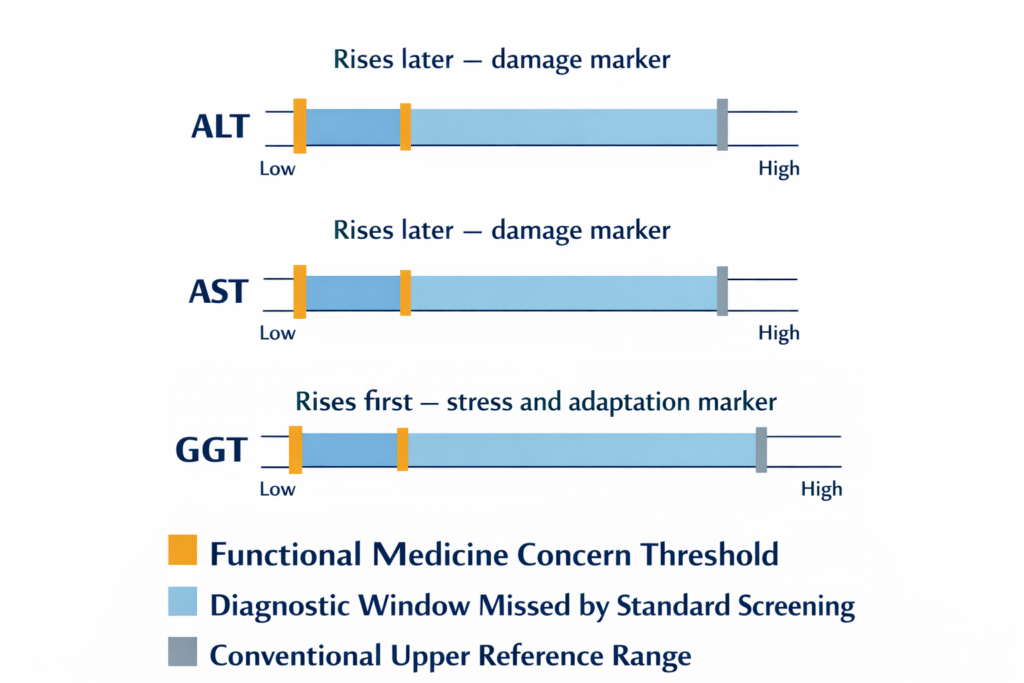
The distinction I make in clinical practice that most patients have never heard before is this: ALT and AST are damage markers. They rise after hepatocytes have already been injured. By the time ALT crosses the conventional upper limit of 56 U/L, meaningful hepatic dysfunction has typically been present for years. GGT is different. GGT is a stress and adaptation marker. It rises when the system is under oxidative, metabolic, or toxic load — before structural damage occurs. It is the liver telling you something is wrong upstream before the injury becomes visible in the other enzymes. That distinction changes everything about how early you can identify and address the problem.
The pattern I see consistently — and it repeats across patients regardless of age, weight, or dietary background — is GGT rising as the earliest signal in a cluster that also includes elevated triglycerides, a TG/HDL ratio above 2.0, and fasting glucose trending above the functional optimal. This combination, read together, is a coherent early insulin resistance picture. GGT is almost always the first marker to move.
It rises before ALT moves, before HbA1c moves, and years before any conventional diagnostic threshold is crossed. In patient after patient, by the time ALT begins to rise, GGT has already been elevated for months or longer — sitting unremarked in a reference range that was never designed to detect metabolic dysfunction at its earliest and most reversible stage.
What happens when I explain this to patients is consistent and significant. I connect the dots in plain language — what GGT is actually measuring, why it is rising, what is happening in the liver and the gut-liver axis that is producing the oxidative and metabolic load this marker reflects, and how their dietary pattern and lifestyle are driving that process. For most patients this is entirely new information. They have been living with these numbers for years.
No one has explained what the numbers mean. When the biological mechanism is explained clearly — not as a lecture but as a direct answer to why they feel the way they feel — the response is almost always the same: they become genuinely motivated to act, because for the first time the intervention makes biological sense to them.
What ALT, AST, and GGT Actually Measure
Before interpreting the numbers, the mechanism behind each enzyme needs to be understood. These three markers are not interchangeable. They measure fundamentally different biological processes, they respond to different stressors, and they rise at different stages of the same metabolic trajectory. Reading them as a set — rather than as three separate isolated values — is what allows them to tell a coherent clinical story.
ALT — Alanine Aminotransferase is an enzyme found predominantly inside hepatocytes — the liver’s primary working cells. Under normal circumstances very little ALT circulates in the bloodstream because it is contained within intact cells. When hepatocytes are damaged or destroyed — by fat accumulation, inflammation, toxin exposure, or ischemia — they release their contents into the bloodstream. ALT rises in the blood as a direct consequence of cellular injury. This makes ALT a damage marker. It measures the consequence of a process that has already occurred, not the process itself. By the time ALT is significantly elevated, the liver has already sustained meaningful injury.
AST — Aspartate Aminotransferase is less liver-specific than ALT. It is found in hepatocytes but also in cardiac muscle, skeletal muscle, kidneys, and red blood cells. An elevated AST alone is therefore less informative than an elevated ALT alone. The AST/ALT ratio — discussed below — is clinically more meaningful than either value in isolation. Like ALT, AST is a damage marker. It rises in response to cellular injury. It does not rise in anticipation of it.
GGT — Gamma-Glutamyl Transferase is mechanistically distinct from both ALT and AST. GGT is a membrane-bound enzyme involved in glutathione metabolism — the body’s primary antioxidant defense system. It is expressed on the outer surface of cell membranes in the liver, kidney, pancreas, and intestinal epithelium, and it plays a central role in amino acid transport and the cellular response to oxidative stress.
GGT rises not primarily in response to cellular damage but in response to oxidative stress, toxic load, metabolic overload, and the induction of the microsomal enzyme system that the liver activates when it is under sustained metabolic or chemical pressure. This makes GGT a stress and adaptation marker — fundamentally different from ALT and AST in what it is measuring and when it rises in the metabolic trajectory.
The Conventional Reference Ranges and Why They Fail
The conventional upper limits for liver enzymes vary slightly between laboratories but typically sit at approximately these levels:
ALT: above 56 U/L in men, above 45 U/L in women
AST: above 40–50 U/L
GGT: above 55–60 U/L in men, above 38–40 U/L in women
These thresholds have a specific origin that is rarely communicated to patients: they are derived from the distribution of values in the general population, with the upper limit set at approximately the 95th or 97.5th percentile of that distribution. They are not derived from studies of optimal metabolic health. They are not derived from the values at which metabolic dysfunction begins. They are derived from what is statistically common — in a population where insulin resistance, fatty liver, and metabolic syndrome are already prevalent in a significant proportion of the reference group.
The result is a reference range calibrated to detect severe hepatic dysfunction in a population that is already metabolically compromised. It is not calibrated to detect early metabolic stress in an individual who wants to identify and correct a problem before it progresses.
The functional medicine thresholds for these markers are substantially lower — because they are derived from the values at which metabolic stress begins to be reflected in the enzyme, not the values at which established disease produces unmistakable elevation.
Functional Medicine Thresholds
ALT — Functional Medicine Thresholds: Below 25 U/L — Optimal. No hepatic metabolic stress signal. 25–35 U/L — Borderline. Monitor trend. Hepatic metabolic stress may be present. Above 35 U/L — Hepatic stress. Warrants investigation for fatty liver, hepatic insulin resistance, and gut-liver axis disruption. Above 56 U/L — Conventional upper limit. By this point hepatic dysfunction is established.
The gap between the functional concern threshold of 35 U/L and the conventional upper limit of 56 U/L represents the diagnostic window that standard screening consistently misses. An ALT of 41 U/L is reported as normal. By functional medicine standards it reflects hepatic metabolic stress that has been developing for months and that will continue to worsen if the upstream drivers are not addressed.
AST — Functional Medicine Thresholds: Below 20 U/L — Optimal. 20–25 U/L — Acceptable. Monitor in context of other markers. Above 25 U/L — Begin contextual assessment. Consider in combination with ALT and GGT. Above 40 U/L — Clinically significant. Requires full metabolic and hepatic assessment.
AST is most useful in combination with ALT through the AST/ALT ratio. A ratio below 1.0 — where ALT is higher than AST — is consistent with non-alcoholic fatty liver disease and metabolic hepatic stress. A ratio above 2.0 — where AST is more than twice ALT — is associated with alcoholic liver disease or more advanced hepatic fibrosis. The ratio provides directional information about the nature of the hepatic stress that neither value alone can offer.
GGT — Functional Medicine Thresholds: Below 20 U/L — Optimal. No oxidative stress or metabolic load signal. 20–30 U/L — Borderline. Early metabolic or oxidative stress signal. Investigate in context. Above 30 U/L — Clinically significant. Reflects oxidative stress, hepatic metabolic burden, gut-liver axis load, or chronic alcohol exposure. Above 55–60 U/L — Conventional upper limit. By this point the stress load has been elevated for a significant period.
The conventional upper limit for GGT sits at 55–60 U/L. The functional medicine concern threshold is above 30 U/L. That gap — from 30 to 55 — represents the entire early and mid-stage metabolic dysfunction window that standard screening ignores. A GGT of 35 U/L is reported as normal in every standard lab in every country. By functional medicine standards it is a clear early signal that the liver is under metabolic and oxidative stress — and that the upstream drivers producing that stress are active and addressable.
GGT: The Earliest Marker in the Metabolic Trajectory
Of the three liver enzymes, GGT is the most clinically important for early metabolic detection — and the most consistently overlooked. Understanding why requires understanding what GGT is actually measuring at the cellular level.
GGT is central to glutathione metabolism. Glutathione is the liver’s primary antioxidant molecule — the compound the liver uses to neutralize reactive oxygen species, detoxify environmental chemicals, and manage the oxidative burden produced by metabolic processes including fat oxidation, de novo lipogenesis, and the detoxification of gut-derived LPS that enters portal circulation from a compromised intestinal barrier. When the liver’s glutathione system is under sustained demand — from insulin resistance producing excess fat oxidation byproducts, from LPS-mediated TLR4 activation generating reactive oxygen species, from chronic fructose metabolism overwhelming hepatic antioxidant capacity — GGT is upregulated. It rises as part of the adaptive response to oxidative stress, not as a consequence of cellular damage.
This is why GGT rises before ALT. ALT waits for cells to be injured. GGT responds to the conditions that will eventually produce that injury — if nothing changes. It is the liver’s early warning system, not its damage report.
The clinical implication is precise: an elevated GGT in the context of normal ALT is not reassurance. It is the most valuable combination pattern available in a standard liver panel — a window in which the metabolic stress is measurable and the structural damage has not yet occurred. This is the intervention window. This is when dietary quality correction, gut-liver axis restoration, and insulin load reduction produce the most complete and durable results.
The Combination Patterns That Matter
Reading ALT, AST, and GGT in isolation misses the information that their combination provides. The following patterns each tell a specific clinical story.
Pattern 1 — GGT elevated, ALT normal This is the earliest and most clinically significant combination. It indicates that the liver is under oxidative and metabolic stress — gut-derived LPS load, insulin-driven de novo lipogenesis, fructose metabolism — but that structural hepatocyte damage has not yet occurred. The intervention window is open. This pattern demands investigation of the upstream drivers: fasting insulin, TG/HDL ratio, dietary pattern, gut health history. It should never be dismissed because ALT is normal.
Pattern 2 — ALT elevated, GGT borderline or normal Less common than Pattern 1. Suggests hepatocyte stress that is metabolic rather than oxidative in origin — most commonly intrahepatic fat accumulation from chronic FFA spillover or sustained de novo lipogenesis. Should always be interpreted alongside fasting insulin and the TG/HDL ratio. If both are elevated, the metabolic origin is almost certain.
Pattern 3 — Both GGT and ALT elevated The oxidative stress that GGT reflects and the cellular damage that ALT reflects are both present simultaneously. This indicates a more established metabolic hepatic dysfunction — typically NAFLD progressing beyond early steatosis. The full marker context — fasting insulin, HOMA-IR, triglycerides, hsCRP, waist circumference — is essential for understanding how many upstream drivers are active.
Pattern 4 — AST/ALT ratio above 2.0 When AST is more than twice the ALT value, the pattern is consistent with alcohol-related liver injury or, in the context of more advanced disease, hepatic fibrosis. In a patient with no significant alcohol history, an AST/ALT ratio above 2.0 warrants further investigation including imaging and hepatology referral.
Pattern 5 — All three elevated with elevated hsCRP This combination — elevated GGT, ALT, and hsCRP together — is the Pattern 4 from the Fix Metabolic Chaos® combination interpretation framework: the Gut-Liver Axis Signal. Elevated liver enzymes combined with systemic inflammation points directly toward gut barrier disruption allowing LPS translocation, hepatic TLR4 activation, and the NF-κB inflammatory cascade impairing insulin signaling across multiple organ systems simultaneously. The gut-liver axis is not a secondary consideration in this picture. It is the primary mechanism.
Pattern 6 — All three within conventional normal range but above functional thresholds GGT at 32, ALT at 38, AST at 26 — all reported as normal by the lab, all above functional concern thresholds. In the context of fasting glucose above 90 mg/dL, TG/HDL ratio above 2.0, and waist circumference above threshold, this is the Compensatory Strain Pattern — the 5 to 10 year warning before conventional markers become abnormal. This is the pattern that standard screening is most comprehensively designed to miss.
What Normal Liver Enzymes Do Not Tell You
One of the most clinically important limitations of liver enzyme testing is that normal values do not exclude hepatic fat accumulation or hepatic insulin resistance. This is not a theoretical concern. It is a documented clinical reality confirmed in multiple studies using liver biopsy and imaging.
A significant proportion of individuals with confirmed hepatic steatosis on ultrasound or MRI have ALT values within the conventional normal range. The reason is mechanistically specific: fat can accumulate inside hepatocytes for months or years before the accumulation reaches a threshold sufficient to produce the cytoplasmic stress that causes cells to release ALT into the bloodstream. The fat is there. The insulin resistance is present. The metabolic dysfunction is established. The enzyme is normal.
This is why liver enzymes must always be interpreted in the context of the full metabolic picture — particularly fasting insulin, HOMA-IR, the TG/HDL ratio, and waist circumference. The combination of normal liver enzymes with elevated fasting insulin, TG/HDL above 2.0, and central adiposity is not reassurance. It is Pattern 3 from the Fix Metabolic Chaos® combination framework: Silent Hepatic Stress — the liver under metabolic strain that the enzymes are not yet reflecting.
Normal ALT does not exclude fatty liver. This is especially important in people with normal body weight, because lean fatty liver disease can develop through insulin resistance, visceral fat, low muscle mass, and impaired hepatic fat export even when BMI appears normal. Hepatic fat accumulation is not only a question of fat production; it is also a question of fat export, and choline deficiency can impair VLDL export and contribute to silent hepatic fat accumulation.
The Markers That Provide Context
ALT, AST, and GGT should never be interpreted without the following contextual markers. Together they provide the full picture that enzymes alone cannot:
Fasting insulin — the primary upstream driver of hepatic fat accumulation through de novo lipogenesis. Elevated fasting insulin with normal liver enzymes is the most important combination that standard screening misses. The liver is producing fat driven by insulin — but the damage has not yet reached the threshold of enzyme elevation.
TG/HDL ratio — the lipid fingerprint of hepatic insulin resistance and hepatic VLDL overproduction. A TG/HDL ratio above 2.0 in mg/dL units in the context of borderline liver enzymes confirms that hepatic metabolic stress is present regardless of what the enzyme values show in isolation.
hsCRP — when elevated above 1.0 mg/L alongside elevated GGT, this combination points directly toward gut-liver axis disruption as the primary mechanism. The gut-liver axis post on this site covers this pathway in full mechanistic detail.
Waist circumference — visceral adipose tissue is the primary source of the portal FFA spillover that drives hepatic fat accumulation and hepatic insulin resistance. Above 94 cm in men and 80 cm in women, visceral fat is a metabolically active driver of the hepatic stress that liver enzymes reflect downstream.
A Note on Uncertainty
The functional medicine thresholds presented in this post — ALT concern above 35 U/L, GGT concern above 30 U/L — are based on the values at which metabolic and oxidative stress begin to be reflected in these enzymes in the research literature and in clinical observation. They represent the consensus of functional and integrative medicine practitioners working with metabolic disease. They are not derived from randomized controlled trials defining optimal enzyme levels with the same rigor as conventional reference ranges.
What is not uncertain is the directional principle: earlier detection produces better outcomes. A GGT of 32 U/L in the context of elevated fasting insulin, a rising TG/HDL ratio, and central adiposity is a metabolic signal worth acting on — regardless of whether the threshold for clinical concern is 30 U/L or 35 U/L. The direction of the marker, read in the context of the full metabolic picture, is what matters clinically.
Practical Implications
If your liver enzymes have been described as normal — or as slightly elevated and worth monitoring — and no one has connected them to your metabolic picture, the following steps are the appropriate clinical response.
Request fasting insulin if it has not already been measured. This is the single most important contextual marker for interpreting liver enzyme elevation in the context of metabolic disease. It is almost never included in standard panels and must be requested specifically.
Calculate your TG/HDL ratio from your existing lipid panel. Divide triglycerides by HDL using the same units — both in mg/dL or both in mmol/L. Above 2.0 in mg/dL units is a functional concern threshold. This ratio is not reported by most standard labs but is present in every standard lipid panel.
Address the gut-liver axis. If GGT is elevated — particularly in combination with hsCRP — the most direct dietary intervention is the elimination of ultra-processed foods, industrial seed oils, and high-fructose corn syrup. These are the primary gut barrier disruptors that drive LPS translocation into portal circulation and the hepatic oxidative stress that GGT reflects.
Use the functional thresholds, not the conventional reference ranges, as your interpretive standard. ALT above 35 U/L warrants metabolic investigation. GGT above 30 U/L warrants metabolic investigation. These thresholds exist because the biology of early metabolic stress operates below the level that conventional ranges are designed to detect.
Your liver enzymes are not just numbers on a panel. They are a communication. ALT and AST tell you when the liver has already been hurt. GGT tells you when it is under strain — before the hurt begins. That distinction, read correctly and acted upon at the right time, is the difference between early intervention and late diagnosis.
People Also Ask
What is the difference between ALT, AST, and GGT?
ALT and AST are damage markers — they rise when hepatocytes are injured and release their contents into the bloodstream. GGT is a stress and adaptation marker — it rises in response to oxidative stress, metabolic overload, and gut-liver axis burden before cellular damage occurs. GGT is therefore the more sensitive early signal for metabolic dysfunction, while ALT and AST reflect consequences that have already developed.
What does a mildly elevated GGT mean?
A mildly elevated GGT — for example between 30 and 55 U/L — sits within the conventional normal range by standard lab criteria but above the functional medicine concern threshold of 30 U/L. In the context of rising triglycerides, a TG/HDL ratio above 2.0, and fasting glucose above 90 mg/dL, a GGT in this range is an early signal of hepatic oxidative stress and metabolic dysfunction that warrants investigation of the upstream drivers — particularly fasting insulin and gut-liver axis integrity — not annual monitoring.
Can you have fatty liver with normal ALT?
Yes — and this is one of the most clinically important limitations of standard liver enzyme testing. Multiple studies using liver biopsy and imaging have confirmed that a significant proportion of individuals with confirmed hepatic steatosis have ALT values within the conventional normal range. Fat accumulates inside hepatocytes before it reaches the threshold that produces enzyme elevation. Normal ALT does not exclude fatty liver. It must always be interpreted alongside fasting insulin, TG/HDL ratio, and imaging where available.
What is the AST/ALT ratio and what does it indicate?
The AST/ALT ratio provides directional information about the nature of hepatic stress. A ratio below 1.0 — where ALT is higher than AST — is consistent with non-alcoholic fatty liver disease and metabolic hepatic stress. A ratio above 2.0 — where AST is more than twice ALT — is associated with alcoholic liver disease or more advanced hepatic fibrosis and warrants further investigation.
What causes GGT to rise without ALT rising?
GGT rises in response to oxidative stress and metabolic load before structural hepatocyte damage occurs. The most common metabolic causes of elevated GGT with normal ALT are early insulin resistance with gut-liver axis disruption, chronic fructose metabolism generating hepatic oxidative stress, visceral adiposity driving portal FFA spillover, and early NAFLD before fat accumulation is sufficient to produce hepatocyte injury. This combination — GGT elevated, ALT normal — is the most important early detection window in liver enzyme interpretation.
What should I do if my liver enzymes are mildly elevated?
Request fasting insulin if it has not been measured. Calculate your TG/HDL ratio from your existing lipid panel. Consider the functional medicine thresholds — ALT concern above 35 U/L, GGT concern above 30 U/L — rather than the conventional reference ranges. If fasting insulin is elevated, the TG/HDL ratio is above 2.0, and GGT is above 30 U/L, the combination points toward early metabolic hepatic stress driven by insulin resistance and gut-liver axis disruption. This is addressable — but only if it is identified correctly.
About the Author
Morteza Ariana is a State-Certified Functional Nutritionist based in Germany, specializing in insulin resistance, type 2 diabetes, and root-cause metabolic restoration. He holds advanced training in systems-based physiology and has worked with patients across the U.S. and Europe for over 10 years.
His clinical framework is built around a core principle that mainstream medicine consistently overlooks: chronically elevated insulin — not blood glucose — is the earliest and most actionable driver of metabolic disease. That conviction was shaped in part by his own experience with hyperinsulinemia in 2016, and deepened through a decade of clinical practice and the study of leading researchers in metabolic medicine including Benjamin Bikman, Joseph Kraft, Gerald Reaven, Jason Fung, and Stephen Phinney.
His work focuses on identifying and correcting the upstream metabolic signals — insulin load, liver-gut axis dysfunction, circadian misalignment, and micronutrient gaps — that standard screening misses entirely. Patient outcomes are documented, anonymized, and published on this site.
If this resonates, the next step is clarity
The Metabolic Restoration Blueprint is a structured 12-week framework designed to correct upstream metabolic drivers — not just manage symptoms.
Key References
1. Lim JS, Mietus-Snyder M, Valente A, Schwarz JM, Lustig RH. The role of fructose in the pathogenesis of NAFLD and the metabolic syndrome. Nature Reviews Gastroenterology and Hepatology. 2010;7(5):251–264. 🔗 https://pubmed.ncbi.nlm.nih.gov/20368739/
2. Targher G, et al. Nonalcoholic fatty liver disease is independently associated with an increased incidence of cardiovascular events in type 2 diabetic patients. Diabetes Care. 2007;30(8):2119–2121. 🔗 https://diabetesjournals.org/care/article/30/8/2119/28529
3. Prati D, Taioli E, Zanella A, et al. Updated definitions of healthy ranges for serum alanine aminotransferase levels. Annals of Internal Medicine. 2002;137(1):1–10. 🔗 https://pubmed.ncbi.nlm.nih.gov/12093239/
4. Whitfield JB. Gamma glutamyl transferase. Critical Reviews in Clinical Laboratory Sciences. 2001;38(4):263–355. 🔗 https://pubmed.ncbi.nlm.nih.gov/11563810/
5. Lee DS, Evans JC, Robins SJ, et al. Gamma glutamyl transferase and metabolic syndrome, cardiovascular disease, and mortality risk. Arteriosclerosis, Thrombosis, and Vascular Biology. 2007;27(1):127–133. 🔗 https://pubmed.ncbi.nlm.nih.gov/17095717/
6. Wannamethee SG, Shaper AG, Lennon L, Whincup PH. Hepatic enzymes, the metabolic syndrome, and the risk of type 2 diabetes in older men. Diabetes Care. 2005;28(12):2913–2918. 🔗 https://pubmed.ncbi.nlm.nih.gov/16306561/
7. Vozarova B, Stefan N, Lindsay RS, et al. High alanine aminotransferase is associated with decreased hepatic insulin sensitivity and predicts the development of type 2 diabetes. Diabetes. 2002;51(6):1889–1895. 🔗 https://pubmed.ncbi.nlm.nih.gov/12031979/
8. Petersen MC, Shulman GI. Mechanisms of insulin action and insulin resistance. Physiological Reviews. 2018;98(4):2133–2223. 🔗 https://pubmed.ncbi.nlm.nih.gov/30067154/
9. Cani PD, et al. Metabolic endotoxemia initiates obesity and insulin resistance. Diabetes. 2007;56(7):1761–1772. 🔗 https://pubmed.ncbi.nlm.nih.gov/17456850/
10. Stefan N, et al. Causes and metabolic consequences of fatty liver. Endocrine Reviews. 2008;29(7):939–960. 🔗 https://pubmed.ncbi.nlm.nih.gov/18778178/